The Knowledge Compression Effect in Integer Gate Logic
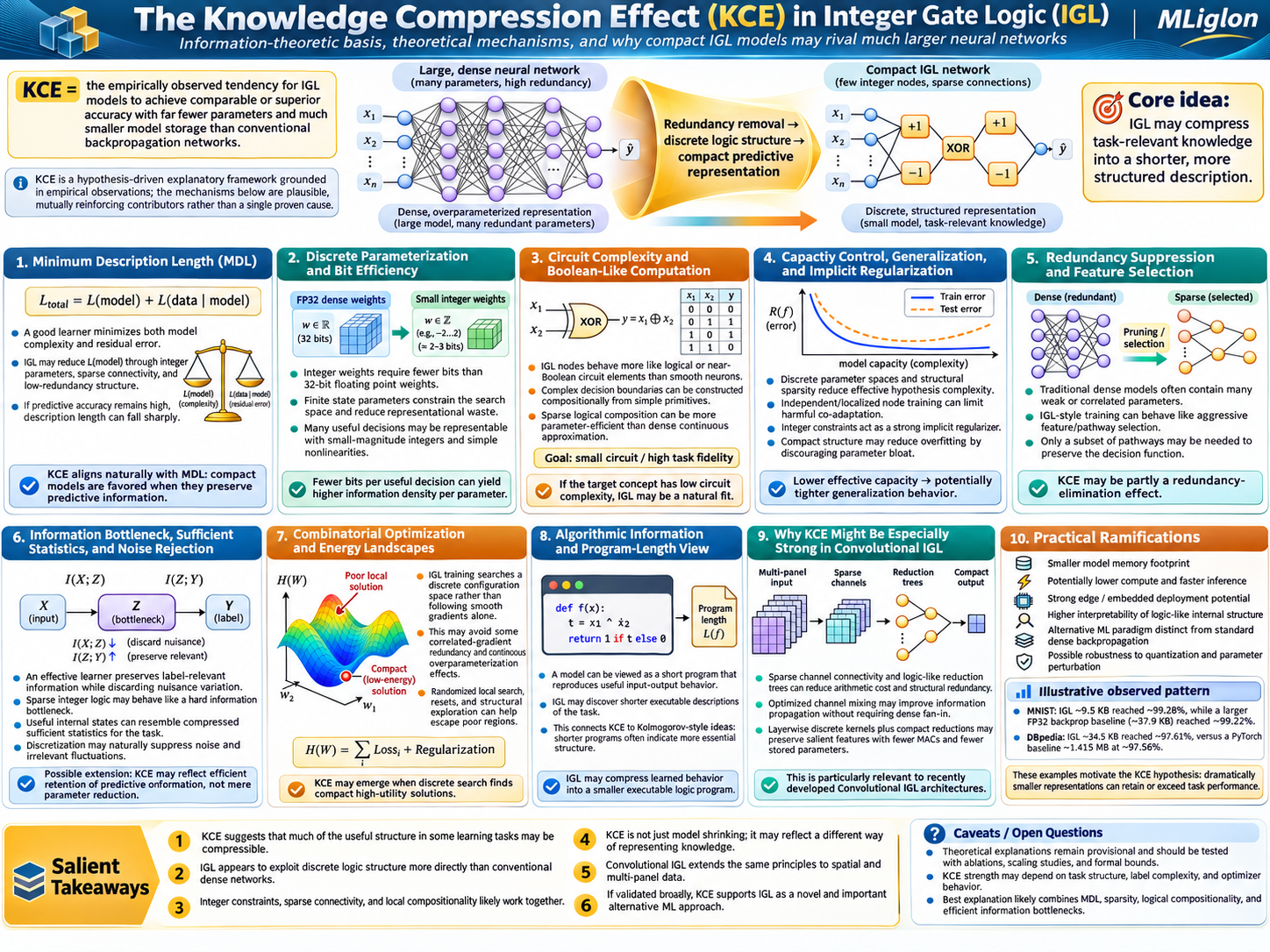
How can a much smaller machine-learning model preserve the predictive capability of a larger one? This infographic explores the proposed Knowledge Compression Effect (KCE) in Integer Gate Logic (IGL): the pattern reported in selected experiments in which compact, integer-based models achieve comparable or better accuracy than larger floating-point reference models. Here, “knowledge compression” refers to representing a learned prediction function efficiently—not to losslessly compressing the original training data. KCE
A shorter description of useful predictive structure
The central idea is that accurate prediction may require substantially less stored complexity than a conventional model uses. The infographic connects this possibility to the Minimum Description Length (MDL) principle, which considers both the description of a model and the information needed to account for what it fails to explain:
Total description length = model description + data description given the model.
From this perspective, a compact model is valuable when it reduces representational cost without sacrificing the information needed for accurate prediction. Small integer parameters, sparse connectivity, and reusable nonlinear computations are possible contributors to such efficiency. However, compact storage alone does not establish that a model minimizes description length. KCE
Several mechanisms may contribute
The graphic organizes the KCE hypothesis around complementary theoretical perspectives. Discrete parameterization can reduce the bits required to represent numerical settings. Circuit complexity and logic-like composition suggest that some decision functions may be expressed economically through combinations of relatively simple nonlinear operations. Redundancy suppression and feature selection offer another explanation: a compact architecture may concentrate its resources on useful relationships rather than maintaining many overlapping computational pathways.
The information-bottleneck perspective asks whether internal representations preserve task-relevant distinctions while discarding nuisance variation. Capacity control and implicit regularization explore whether constraints on parameters and connectivity can discourage unnecessary complexity. Finally, algorithmic information theory provides a broader analogy: a trained model can be viewed as an executable description of predictive behavior, and some behaviors may admit much shorter descriptions than others.
Why convolutional IGL is particularly interesting
Convolutional IGL combines local spatial processing with sparse channel connections and nonlinear reduction structures. Optimized channel mixing and adaptive connectivity allow the model to investigate which features should interact, as well as how those features should be transformed. This creates opportunities to construct useful cross-panel relationships before global pooling compresses spatial feature maps into summary values.
The illustrated transition from a large network to a compact IGL network is conceptual. It does not imply that IGL must first train and then compress a larger floating-point model; its compact integer representation can be optimized directly.
Potential implications—and the evidence still needed
If supported across broader, controlled evaluations, KCE could help explain how IGL delivers useful prediction capability with smaller model storage and potentially lower deployment costs. Those characteristics are relevant to embedded inference, edge AI, and other resource-constrained applications.
The infographic presents a research framework, not a proven unified theory. Its mechanisms are plausible explanations to investigate, not guarantees of superior accuracy, optimal compression, interpretability, or generalization. The decisive question is whether IGL consistently preserves task-relevant predictive performance in a smaller deployed representation—and which architectural and training mechanisms are responsible.