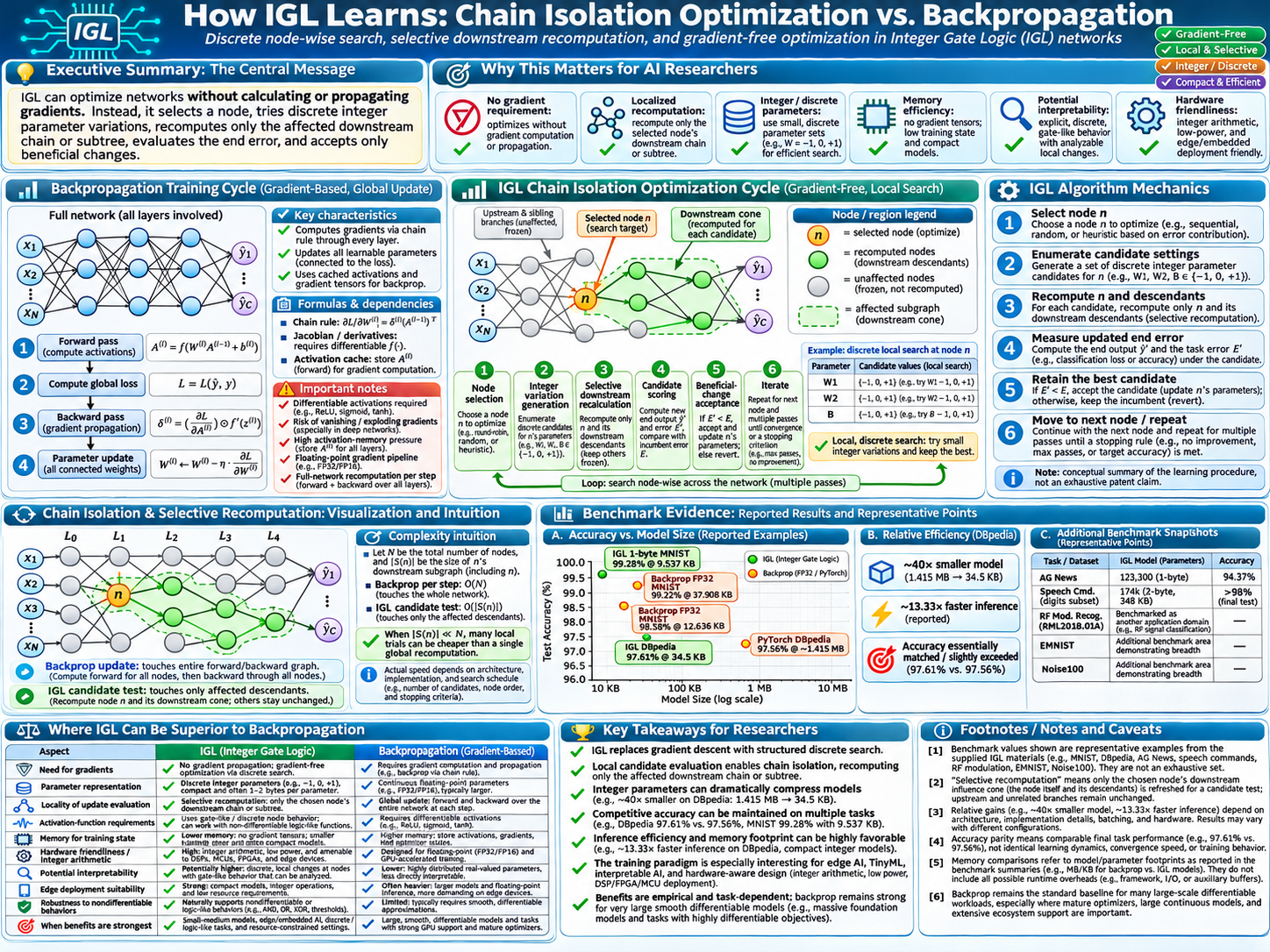
How IGL Learns: Chain Isolation Optimization Versus Conventional Backpropagation
MLiglon Corporation’s patented Integer Gate Logic (IGL) architecture employs a distinctive gradient-free training methodology known as chain isolation optimization, providing an alternative to conventional neural-network training through error backpropagation.
Traditional backpropagation computes loss gradients throughout a neural network using the chain rule, then adjusts weights and biases through gradient-based optimization. In contrast, IGL evaluates discrete parameter changes directly, measuring how each candidate adjustment affects the network’s prediction error without requiring derivative calculations or backward gradient propagation.
A key characteristic of chain isolation is selective downstream recomputation. When a node’s parameters are modified, previously calculated outputs from unaffected nodes can be reused, while only the computational dependencies influenced by the change are recalculated. This can substantially reduce redundant processing when the affected network region is relatively small.
The methodology also offers opportunities for massively parallel training on multicore CPUs and NVIDIA GPUs using CUDA. Independent candidate parameter configurations and training samples can be evaluated concurrently, with their resulting errors combined to identify beneficial updates.
Together, these characteristics support research into compact integer-based neural networks, discrete optimization, computational reuse, and efficient training across heterogeneous computing platforms.
Technical note: Chain isolation eliminates the need for conventional gradient backpropagation but still requires computational resources to evaluate candidate parameter changes. Actual training efficiency depends on network topology, affected-chain size, candidate-search strategy, parallelization, and hardware implementation. Reduced computation per candidate does not necessarily guarantee lower total training time compared with optimized backpropagation.