Video Chapters & Timeline
Choose a chapter to jump to that point in the 29-minute video. Expand a section to see its topics.
01 Start Here — Foundations 00:00–06:43
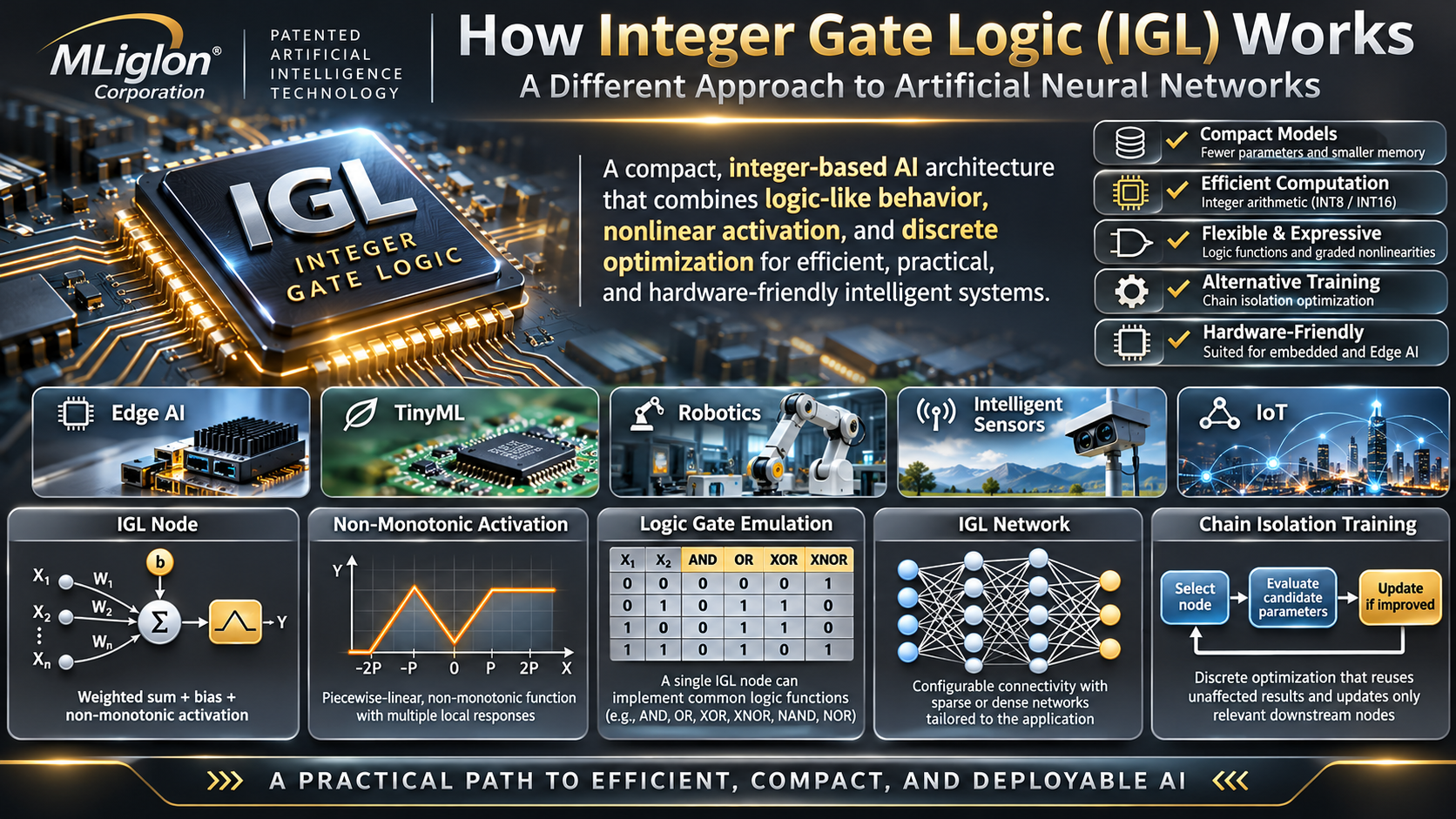
- 00:00Introduction to Integer Gate Logic (IGL)Discover MLiglon’s alternative approach to artificial neural networks and compact, integer-based AI.
- 01:06Small Decisions, Big Computing ConstraintsWhy efficient AI matters for embedded devices, sensors, robotics, and resource-limited applications.
- 01:59Conventional Neural Networks vs. IGLCompare gradient backpropagation with the architectural differences introduced by IGL.
- 02:56Inside an Integer Gate Logic NodeExplore integer weights, input signals, bias, activation scaling, and node computation.
- 04:01The Five-Region Activation FunctionSee how a non-monotonic, piecewise-linear activation supports distinctive nonlinear responses.
- 04:52Demonstrating XOR With a Single NodeFollow a worked example of XOR behavior using one IGL node.
- 05:46Six Logic Functions, One Node ArchitectureSee AND, OR, XOR, XNOR, NAND, and NOR behavior using different integer configurations.
02 Networks & Training 06:43–14:37
- 06:43Building Complete IGL Neural NetworksConnect individual nodes into layered networks with configurable dependencies.
- 07:37Beyond Boolean LogicExplore graded nonlinear responses beyond strictly binary gate outputs.
- 08:28Training Without Conventional BackpropagationUnderstand discrete optimization and candidate parameter changes.
- 09:31Chain Isolation OptimizationLearn how unaffected outputs may be reused while recalculating relevant downstream nodes.
- 10:46CPU and GPU Parallel TrainingExplore candidate evaluation, computational reuse, and parallel acceleration.
- 11:44IGL Inference After TrainingSee how trained parameters and network connections produce forward inference.
- 12:33Compact Parameter StorageCompare FP32, INT16, and INT8 storage, distinguishing weights from total RAM use.
- 13:39Beyond Conventional Neural Network QuantizationUnderstand how IGL differs from simply converting standard network weights to INT8.
03 Edge AI & Applications 14:37–18:36
- 14:37Why IGL Is Promising for Edge AIConsider on-device intelligence, network independence, and hardware constraints.
- 15:28TinyML and Intelligent SensorsExplore acoustic detection, vibration monitoring, and embedded classification.
- 16:25Robotics and Real-Time Decision-MakingConsider responsive robotic sensing, perception, and local control.
- 17:28Industrial IoT and RF CommunicationsExplore predictive maintenance, wireless classification, and local monitoring.
04 Evidence, Benchmarks & Patents 18:36–22:19
- 18:36Reported IGL Benchmark ResultsReview selected MNIST and DBpedia accuracy and parameter-storage results.
- 19:44AG News Classification ResultsExamine reported four-class text classification results and comparison considerations.
- 20:48From Research Results to Real HardwareExplore the importance of measuring accuracy, memory, latency, and energy on actual devices.
- 21:34MLiglon’s Granted U.S. PatentsUnderstand the intellectual-property foundation of IGL and its training methodology.
05 Interactive Demo, Questions & Next Steps 22:19–28:59
- 22:19Introducing the Interactive IGL LaboratoryPreview logic functions, integer parameters, activation curves, and response surfaces.
- 23:04Experiment With IGL YourselfChange weights and bias, choose gates, and observe changes interactively.
- 23:56Evaluating IGL Through Practical Pilot ProjectsReview a reproducible plan for matched comparisons on target hardware.
- 24:43Is IGL Simply Another INT8 Neural Network?Clarify the architectural and training differences beyond quantization.
- 25:30Potential Commercial ApplicationsConsider uses in sensors, RF systems, robotics, and specialized embedded AI.
- 26:19Does a Smaller AI Model Consume Less Energy?Understand why energy must be measured, not inferred from model size alone.
- 27:11Explore the Research and CollaborateFind technical resources, benchmark reports, patents, and contact opportunities.
- 27:58Conclusion: A Different Path to Practical AISummarize the opportunity and continue exploring on MLiglon.com.
Speakers: Richard, Justin, Patrick, Sarah, and Rachel (29 minutes).
Production note: This presentation uses AI-generated narration and illustrations to explain MLiglon’s published technology and research. The named presenters are synthetic voices.
Discover a different approach to artificial intelligence in this engaging 29-minute introduction to MLiglon Corporation’s patented Integer Gate Logic (IGL) technology. Explore how IGL uses compact integer-based neural networks, logic-like activation functions, and an alternative training methodology to address challenging AI problems. Through detailed graphics, practical examples, and reported benchmark results, learn why IGL is attracting interest for Edge AI, robotics, intelligent sensors, and resource-constrained computing. Then experience the technology firsthand in MLiglon’s Interactive IGL Laboratory.