Integer Gate Logic Scaling: Model Complexity, Parameter Efficiency, and Neural-Network Growth
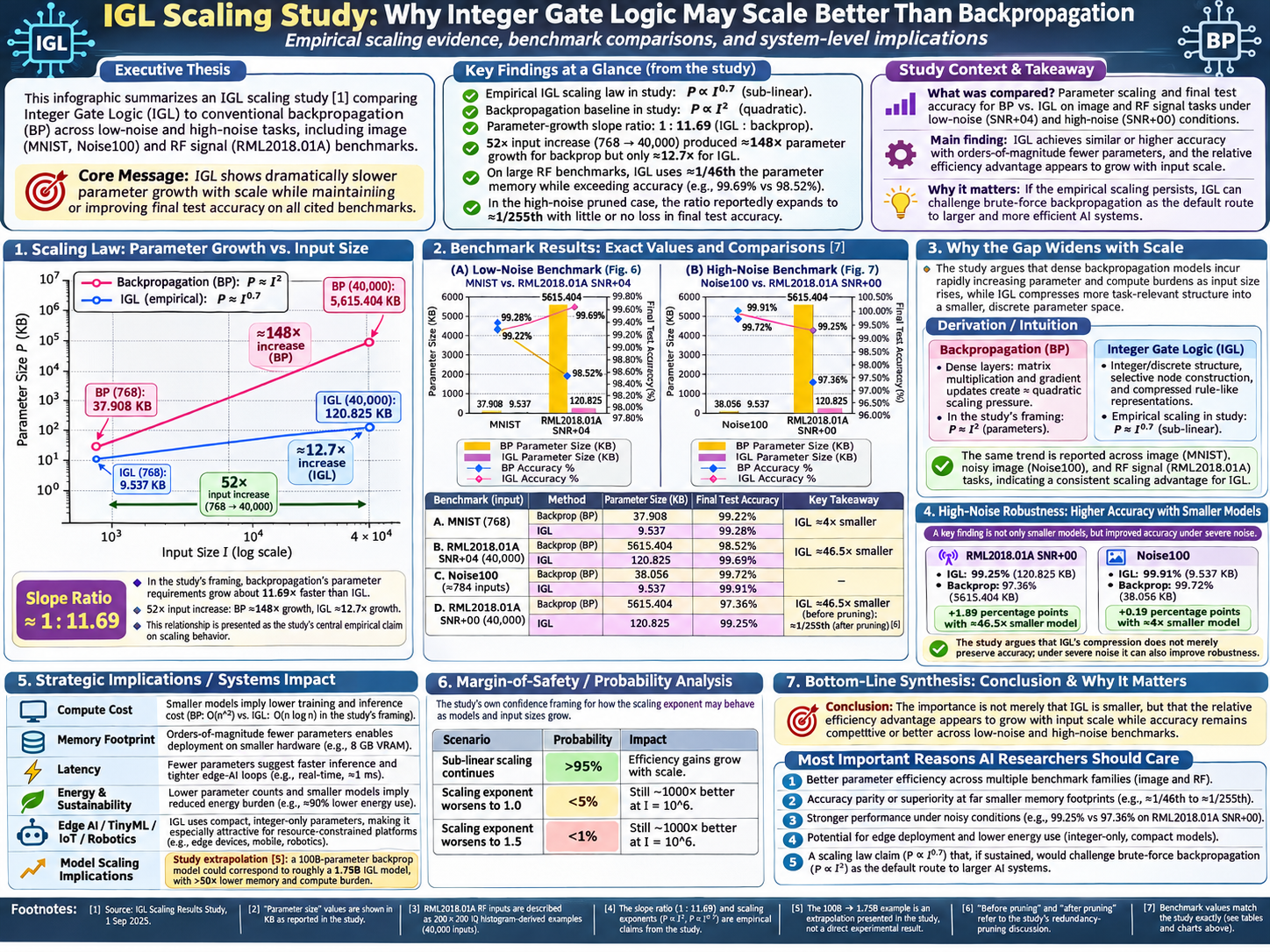
MLiglon Corporation’s patented Integer Gate Logic (IGL) architecture offers a promising alternative approach to scaling artificial neural networks through compact integer-valued parameters, logic-capable computational nodes, and selective network connectivity.
Conventional neural networks frequently require increasing numbers of parameters, computational operations, and memory resources as model capacity grows. IGL investigates whether its specialized nonlinear activation functions and discrete computational architecture can represent complex relationships with fewer learned parameters and reduced memory requirements, while maintaining competitive classification accuracy.
MLiglon’s experimental scaling study examined the relationship between model size, input complexity, and classification performance across several benchmark configurations. The reported results suggested sublinear parameter growth for the tested IGL models, with an approximate empirical relationship of (P ^0.7), where (P) represents parameter count and (I) represents the study’s input-size measure. The selected conventional backpropagation-trained baseline configurations exhibited substantially greater parameter growth.
These findings motivate further research into parameter-efficient scaling, sparse connectivity, integer-native computation, and larger IGL architectures. Reduced parameter growth could be particularly valuable for embedded AI, TinyML, edge computing, and applications constrained by memory capacity or computational resources.
Technical note: The reported scaling relationship is an empirical observation from a limited set of experiments using different architectures and datasets, not a proven universal scaling law. Conventional neural networks do not inherently require quadratic parameter growth, and larger controlled studies are necessary to establish how IGL parameter efficiency, accuracy, training cost, and inference performance scale with increasing problem complexity.