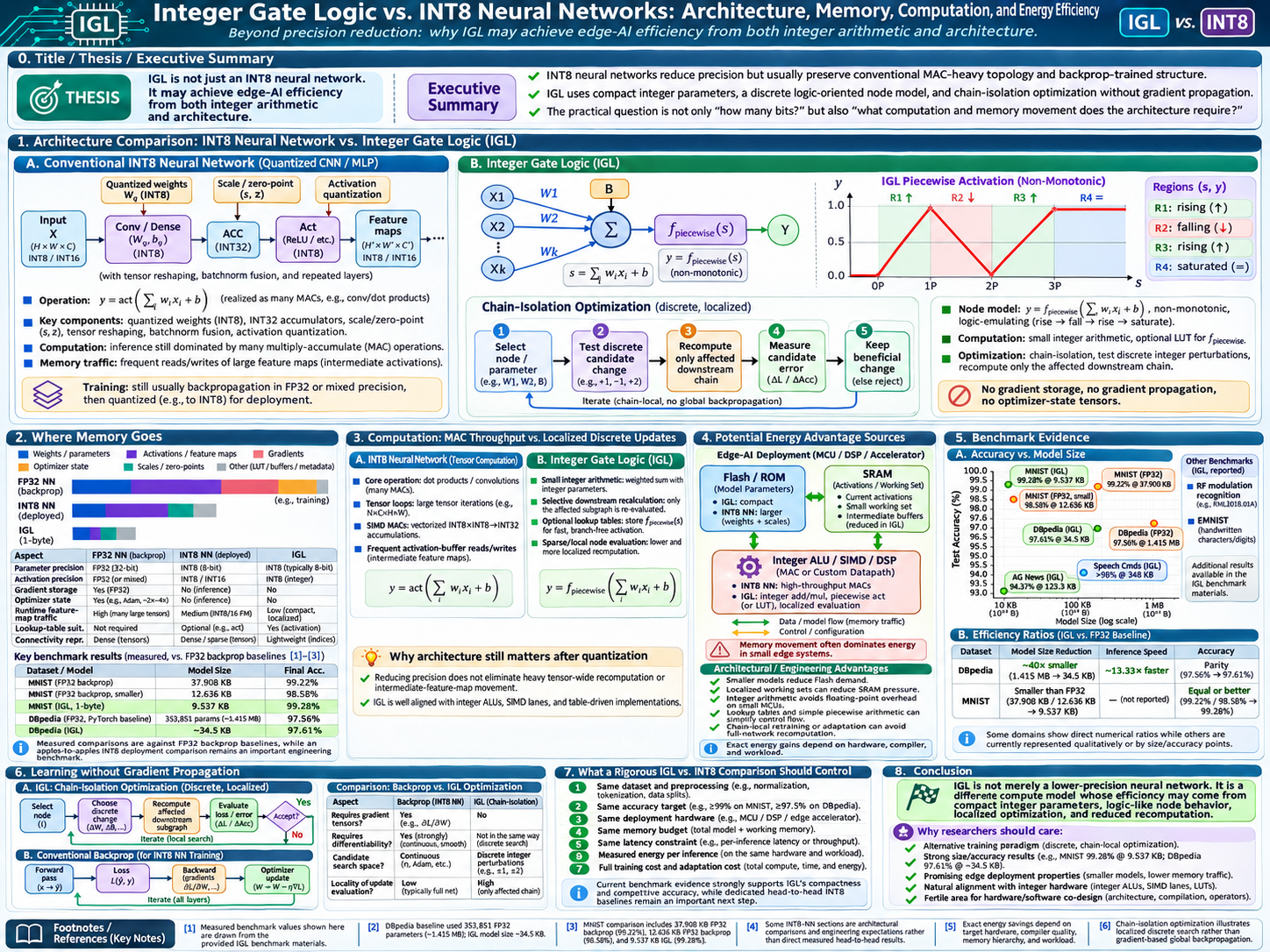
Integer Gate Logic vs. INT8 Neural Networks: Beyond Quantization to Architectural Efficiency
A Different Approach to Building Efficient Artificial Intelligence
Modern artificial intelligence increasingly depends on low-precision computation to reduce memory requirements, improve inference throughput, and enable machine-learning models to operate on resource-constrained hardware.
One of the most widely adopted approaches is neural-network quantization: converting the floating-point weights and activations of conventional neural networks into smaller numerical representations, commonly INT8 or INT16.
Quantization has enabled important advances in Edge AI, TinyML, mobile inference, industrial automation, and embedded machine learning. However, quantization generally preserves the underlying computational structure of the original neural network.
Integer Gate Logic (IGL), a patented machine-learning technology developed by MLiglon Corporation, takes a fundamentally different approach. Rather than simply reducing the numerical precision of conventional neural-network parameters, IGL introduces a distinctive computational architecture built around integer-valued parameters, logic-oriented nonlinear activation functions, and discrete optimization without conventional backpropagation.
This distinction raises an important engineering question:
What additional efficiency can be achieved by redesigning the computational architecture itself, rather than merely reducing the number of bits used to represent its parameters?
IGL’s benchmark results suggest that architectural innovation can offer substantial opportunities for reducing model size while maintaining competitive classification accuracy.
Understanding these opportunities requires examining four related dimensions: computational architecture, memory utilization, execution efficiency, and energy consumption.
1. Conventional INT8 Neural Networks: Efficient Arithmetic Within a Familiar Architecture
Conventional artificial neural networks generally learn through gradient-based optimization. During training, parameters are adjusted using derivatives of a loss function, commonly calculated through backpropagation.
After training, the model can be deployed using floating-point arithmetic or converted to lower-precision representations.
For example, an FP32 convolutional neural network can be quantized so that its weights and intermediate activations use INT8 values.
A conventional quantized neuron still performs a weighted accumulation:
S = Σ(WᵢXᵢ) + B
The result is passed through an activation function, such as ReLU, and subsequent layers process the resulting values.
INT8 inference implementations commonly perform multiplication using 8-bit operands, accumulate into wider integer registers such as INT32, and apply scaling or requantization to produce the next layer’s activation values.
Advantages of conventional INT8 quantization
Quantization can deliver substantial benefits.
An INT8 weight requires one byte instead of four bytes for an FP32 weight. Consequently, an unchanged collection of weights requires only one-quarter the raw parameter storage.
Smaller weights can also reduce memory bandwidth requirements and improve cache utilization.
Many embedded processors, GPUs, and AI accelerators provide efficient integer multiply-and-accumulate instructions, making INT8 inference attractive for practical deployment.
These improvements explain why quantization has become an important component of modern AI engineering.
What quantization does not necessarily change
Quantization does not automatically reduce the number of neurons, convolutional filters, network layers, or parameter connections.
A conventional network containing one million weights may still contain approximately one million weights after conversion to INT8.
The representation becomes smaller, but the network’s computational topology may remain largely unchanged.
Similarly, the number of multiply-and-accumulate operations may remain approximately the same unless additional optimization techniques, such as pruning, sparsification, or architecture redesign, are employed.
This is where IGL introduces a different set of design possibilities.
2. IGL: An Integer-Native Computational Architecture
Integer Gate Logic uses computational nodes that combine integer-weighted inputs with a specialized piecewise activation function.
For a basic two-input node:
S = W₁X₁ + W₂X₂ + B
Y = f(S)
Here, W₁ and W₂ are learned weights, B is a learned bias, and f(S) is the IGL activation function.
Unlike conventional monotonic activation functions, the patented IGL activation can increase, decrease, increase again, and ultimately saturate.
This non-monotonic structure is essential to the architecture’s ability to emulate Boolean and graded logic functions.
Depending on the weights and bias, a node can reproduce behaviors analogous to AND, OR, XOR, XNOR, NAND, NOR, and other nonlinear functions.
A distinctive form of computational expressiveness
Consider the XOR function, which produces a positive output when exactly one of two binary inputs is active.
A single conventional neuron using a monotonic threshold activation cannot implement XOR because the function is not linearly separable.
IGL can reproduce XOR using a single two-input node with appropriately selected weights and bias.
For the normalized activation function, one configuration is:
W₁ = 1, W₂ = 1, B = 0
The weighted sums for inputs (0,0), (0,1), (1,0), and (1,1) become:
0, 1, 1, 2
The IGL activation maps these values to:
0, 1, 1, 0
This reproduces the XOR truth table exactly.
The significance is not that XOR is difficult for conventional multilayer neural networks. Rather, the example illustrates how IGL can express certain nonlinear relationships using particularly compact computational structures.
Networks composed of such nodes can potentially represent useful feature interactions with fewer learned parameters for suitable problems.
3. Architectural Compression Versus Numerical Compression
One of the most important distinctions between IGL and conventional quantized neural networks is the difference between two forms of compression.
Numerical compression
Numerical compression reduces the number of bits used to represent parameters.
Converting FP32 weights to INT8 reduces the raw storage per weight from four bytes to one byte.
This provides a theoretical fourfold reduction in weight storage when parameter counts remain unchanged and additional quantization metadata is excluded.
Architectural compression
Architectural compression reduces the amount of computational structure required to represent a learned function.
This may involve fewer parameters, sparse connectivity, fewer computational nodes, or more expressive individual nodes.
IGL’s logic-capable activation functions and configurable network connectivity create opportunities for this second type of compression.
Why the distinction matters
Suppose two models perform the same classification task.
The conventional model contains 100,000 FP32 parameters, occupying approximately 400 KB.
Quantizing those parameters to INT8 would reduce their raw storage to approximately 100 KB, assuming the parameter count remains unchanged.
Now suppose a different architecture achieves comparable accuracy with only 20,000 INT8 parameters.
Its raw parameter storage would be approximately 20 KB.
The first improvement comes from reducing parameter precision.
The second comes from representing the required computation using fewer parameters.
IGL’s most interesting potential advantage is the combination of compact numerical representations with more efficient architectural representations.
However, demonstrating this advantage requires comparisons against conventional networks that have also been quantized and architecturally optimized.
4. Benchmark Evidence: MNIST, AG News, and DBpedia
MLiglon’s reported benchmarks provide evidence that IGL can achieve strong classification performance using substantially smaller parameter representations than selected conventional FP32 neural networks.
These experiments cover image recognition and natural-language classification, providing useful examples across different input modalities.
| Benchmark | IGL accuracy | FP32 baseline accuracy | IGL parameter storage | FP32 baseline storage | Reported storage reduction |
|---|---|---|---|---|---|
| MNIST | 99.28% | 99.22% | 9.537 KB | 37.908 KB | 3.97× |
| EMNIST Digits | 99.26% | 99.12% | 9.537 KB | 38.188 KB | 4.00× |
| Noise100 | 99.91% | 99.72% | 9.537 KB | 38.056 KB | 3.99× |
| AG News | 94.57% | 94.22% | 0.060 MB | 1.415 MB | 23.42× |
| DBpedia | 97.61% | 97.56% | 35,408 bytes | 1,415,404 bytes | 39.97× |
All comparisons are based on the architectures and experimental conditions described in the corresponding MLiglon studies.
MNIST: Compact parameter representation
In the July 2025 MNIST study, IGL achieved 99.28% final-test accuracy using 9.537 KB of one-byte parameters.
The selected FP32 baseline achieved 99.22% using 37.908 KB.
This demonstrates approximately fourfold parameter-storage efficiency at comparable accuracy.
Because the models contain approximately similar numbers of stored parameters, much of this particular storage advantage comes directly from integer precision.
The important additional observation is that the tested IGL architecture maintained strong classification accuracy using those compact values.
AG News: More substantial architectural differences
The October 2025 AG News study provides a more striking example.
An IGL model containing 30,204 two-byte parameters, occupying approximately 60 KB, achieved 94.57% test accuracy.
The PyTorch FP32 baseline contained 353,851 parameters, requiring approximately 1.415 MB, and achieved 94.22%.
The reported storage reduction was approximately 23.4-fold.
This difference is considerably larger than the factor of two attributable to converting FP32 weights to INT16.
It therefore reflects a substantial difference in the number of stored parameters as well as their numerical precision.
The study also reported approximately 36.09× shorter training time for the tested IGL implementation.
This training result is implementation-specific and should not be interpreted as a universal speed advantage over all optimized PyTorch networks.
Nevertheless, it provides a compelling motivation for investigating discrete optimization and alternative model architectures.
DBpedia: A particularly important result
The December 2025 DBpedia ontology-classification benchmark offers one of the clearest demonstrations of IGL’s potential.
The tested PyTorch model contained 353,851 FP32 parameters, occupying 1,415,404 bytes.
The IGL implementation employed a sparse computational structure with 10,068 nodes and a reported parameter-storage requirement of 35,408 bytes.
Final-test accuracy was 97.61% for IGL and 97.56% for PyTorch.
The storage reduction was approximately 40-fold, with essentially equivalent reported accuracy.
The benchmark also measured inference execution on an NVIDIA RTX 4090 GPU.
The reported timings were approximately:
- PyTorch: 800,000 microseconds.
- IGL: 60,000 microseconds.
This corresponds to approximately 13.33× lower measured inference time for the reported evaluation workload.
These measurements are particularly interesting because they suggest that the efficiency of the tested IGL implementation extended beyond parameter storage into execution time.
The figures should not be interpreted as universal per-sample latency measurements or guaranteed performance on other hardware.
5. A Critical Engineering Question: What Happens When the Baseline Is Also INT8?
For a rigorous assessment of IGL’s architectural efficiency, conventional FP32 baselines are only the starting point.
Modern embedded AI systems frequently use quantized INT8 networks, making these comparisons especially important.
Consider the DBpedia experiment.
The FP32 baseline uses 353,851 parameters.
If those same parameters could be represented using one byte each, the resulting raw weight storage would be approximately 353,851 bytes.
The reported IGL storage requirement is 35,408 bytes.
This produces a hypothetical parameter-storage ratio of approximately 10 to one.
However, this is only a numerical comparison.
It does not establish that a quantized INT8 version of the baseline would preserve its original accuracy, achieve the same inference throughput, or require no additional scales, connectivity information, or runtime buffers.
Neither does the reported IGL parameter size necessarily include every byte required for the complete deployed implementation.
A proper engineering comparison must therefore measure both models after deployment optimization.
The ideal comparison
A rigorous experiment would compare:
- An optimized conventional FP32 network.
- A post-training-quantized INT8 version.
- A quantization-aware-trained INT8 network.
- A suitably optimized INT16 implementation.
- An integer-native IGL network.
- Where appropriate, a convolutional IGL implementation.
All models should use the same input representation, training and test partitions, comparable accuracy targets, and hardware.
This would reveal how much efficiency comes from parameter precision, architecture, sparsity, activation implementation, and training strategy.
Such a study would provide particularly valuable evidence for organizations evaluating IGL for licensing or embedded deployment.
6. Computational Efficiency: MAC Operations, Activations, and Memory Traffic
A conventional INT8 neural network often performs substantial numbers of integer multiply-and-accumulate operations.
Convolutional networks repeatedly apply filters across feature maps, and dense layers perform dot products over input vectors.
The associated operations are highly optimized on many existing hardware platforms.
IGL also performs weighted arithmetic, so the use of integer operations alone does not eliminate multiply-and-accumulate work.
Its possible advantage depends on whether the architecture requires fewer computational elements, fewer parameter accesses, or less total arithmetic to achieve the required accuracy.
Compact logic-capable nodes
IGL nodes can express nonlinear decision functions through a fixed piecewise activation.
For suitable classification tasks, these capabilities may reduce the number of nodes or layers needed to express certain relationships.
Sparse network connectivity
IGL architectures can use sparse or selectively structured interconnections.
Reducing unnecessary connections may decrease parameter storage and arithmetic work.
However, sparse structures can introduce indexing and memory-access overhead, so implementation details matter.
Lookup-table activation
The IGL activation function can be implemented through integer arithmetic or a lookup table when the input range is suitably bounded.
A table can replace repeated piecewise calculations with indexed memory accesses.
Whether this improves performance depends on table size, cache residency, memory latency, and processor instruction capabilities.
Computation is not the only bottleneck
In embedded systems, memory transfers can contribute substantially to execution time and power consumption.
Reducing the amount of data moved from Flash, external memory, or DRAM into processing registers may yield important benefits.
Consequently, an accurate performance comparison should measure more than arithmetic operation counts.
It should also consider memory transfers, cache behavior, working-buffer requirements, and total execution time.
7. Runtime Memory: Beyond the Parameter File
Raw parameter storage is an important measurement, but it is not equivalent to complete runtime memory consumption.
Both conventional INT8 networks and IGL implementations may require additional memory for intermediate computations.
Conventional INT8 neural networks
Typical memory components include quantized weights, activation feature maps, integer accumulators, quantization scales, temporary buffers, and framework-specific execution structures.
Convolutional networks can require substantial activation memory, especially when processing large feature maps or retaining multiple intermediate tensors.
IGL networks
Typical memory components may include integer weights and biases, intermediate node outputs, connectivity metadata, input buffers, and other working storage.
A compact IGL model may benefit from selective computation and carefully managed intermediate values.
However, sparse graph representations may require explicit connection indices, and convolutional IGL implementations still need appropriate feature-map storage.
Training memory versus inference memory
This distinction is particularly important.
Conventional backpropagation training often requires additional storage for gradients, intermediate activations, and optimizer state.
A deployed conventional INT8 inference model does not normally require those training-only structures.
Similarly, IGL’s chain isolation optimization is primarily relevant to how the model is trained or adapted.
Comparing IGL inference memory against conventional backpropagation training memory would not be an equivalent comparison.
For deployment decisions, both systems should be evaluated in their inference configurations, with complete accounting of all required memory.
8. Training Without Gradient Backpropagation
IGL introduces another important difference through its optimization process.
Conventional neural networks generally learn using gradient descent or related algorithms.
Backpropagation determines how changes to parameters influence a loss function by propagating derivatives backward through the network.
IGL instead investigates discrete parameter changes through its chain isolation optimization approach.
In simplified form, training involves selecting a node, generating candidate parameter adjustments, evaluating the affected computations, measuring the resulting prediction error, and retaining beneficial changes according to the optimization criteria.
Localized computation
When a node is modified, portions of the computational graph that cannot be affected by the change may retain their previously calculated values.
Only the downstream dependencies influenced by the candidate change need to be reconsidered.
This offers a potential opportunity to reduce repeated computation during discrete parameter search.
The benefit depends on graph connectivity, caching strategy, candidate selection, and the cost of evaluating alternative parameters.
For shared convolutional kernels, changing a kernel coefficient can affect many spatial locations, so the amount of recomputation may be substantial.
No derivative requirement
Since candidate changes are evaluated directly, the training procedure does not require the activation function to be differentiable.
This enables the use of non-monotonic logic-oriented functions that are less convenient for conventional gradient optimization.
An alternative, not an automatic speed advantage
Discrete candidate search can be computationally expensive, particularly when many alternatives must be evaluated.
For this reason, eliminating backpropagation does not automatically guarantee faster training.
The relevant question is whether the selected IGL optimization method reaches a useful accuracy target using fewer computational resources on a particular task.
The reported AG News training comparison provides encouraging evidence for further investigation, but broader evaluation remains necessary.
9. Potential Energy Efficiency Advantages
Energy efficiency is especially important for microcontrollers, industrial sensors, battery-powered IoT devices, robotics, and always-on edge systems.
IGL offers several potential sources of energy reduction.
Smaller parameter transfers
Compact models can require less movement of parameter data between memory and processing units.
On hardware where memory access consumes substantial energy, this may be beneficial.
Efficient integer operations
Low-precision integer arithmetic can be highly efficient on many embedded processors.
However, this benefit is not unique to IGL, since conventional quantized networks also exploit integer instructions.
Reduced computational structure
If an IGL network achieves equivalent accuracy using fewer nodes, connections, or operations, the total execution workload may decrease.
Specialized activation execution
Piecewise arithmetic or compact activation lookup tables may provide opportunities for hardware-oriented optimization.
More efficient local inference
A model small enough to execute on a sensor or microcontroller may reduce reliance on communication with remote processing systems.
This could lower system-level energy consumption when transmitting data is more expensive than performing local inference.
Why energy improvements must be measured
A model that uses fewer parameters does not necessarily consume proportionally less energy.
Actual energy per inference depends on processor voltage, clock frequency, instruction mix, memory accesses, cache behavior, active execution time, and peripheral activity.
For engineering evaluation, the most useful metric is:
Energy per completed inference at a specified accuracy and latency requirement.
Direct measurements on representative microcontrollers and DSPs would provide stronger evidence than estimates based on parameter count alone.
10. Hardware Deployment: ARM, DSPs, and Specialized Accelerators
The architectural differences between IGL and conventional INT8 networks are particularly relevant to embedded hardware design.
ARM Cortex-M microcontrollers
Small microcontrollers frequently provide limited SRAM and Flash storage, making compact model representations attractive.
IGL’s integer arithmetic and potential lookup-table execution could be implemented without relying on large floating-point libraries.
Relevant deployment measurements include Flash consumption, peak SRAM, processor cycles, worst-case latency, and energy per prediction.
Digital signal processors
DSP architectures provide efficient integer arithmetic and often support SIMD or vector operations.
IGL computations may benefit from these capabilities when independent node operations can be grouped appropriately.
The feasibility and efficiency of vectorization depend on the data layout, precision, connectivity, and instruction-set capabilities of the target processor.
FPGA and ASIC implementations
IGL nodes can potentially be mapped to combinations of integer arithmetic units, comparison logic, lookup tables, and on-chip memory.
Specialized implementations might exploit parallel evaluation and compact parameter representations.
The appropriate design would depend on throughput requirements, resource utilization, clock frequency, and power constraints.
Hardware-aware optimization
A particularly promising research direction is the joint optimization of IGL architecture and target hardware.
Rather than training an architecture independently and adapting it afterward, the model could be developed with the intended processor’s memory hierarchy, arithmetic capabilities, and execution constraints in mind.
11. Where IGL May Offer the Greatest Advantages
IGL is particularly worth investigating when model size, memory traffic, and embedded execution constraints have greater importance than compatibility with conventional large-scale neural-network infrastructure.
| Application requirement | Potential IGL advantage |
|---|---|
| Restricted Flash or SRAM | Compact integer parameter representations |
| Strong nonlinear feature interactions | Logic-capable nodes, including XOR-like behavior |
| Integer-only hardware | Native discrete arithmetic |
| Low memory bandwidth | Potentially fewer bytes transferred |
| Compact embedded classifiers | Opportunities for sparse architectures and fewer parameters |
| DSP or accelerator deployment | Integer operations and configurable computation |
| Alternative training methods | Discrete parameter search without gradients |
| Local sensor inference | Small models that can operate near the data source |
| Energy-constrained systems | Potential reductions in arithmetic and memory movement |
Potential applications include industrial condition monitoring, acoustic event recognition, RF modulation classification, embedded vision, smart sensors, motor-state recognition, robotics, and distributed IoT systems.
These are application opportunities, not guarantees of superior performance.
Conventional INT8 CNNs remain highly competitive and benefit from mature software libraries, optimized inference kernels, established deployment tools, and broad hardware support.
The central opportunity for IGL is to determine whether its different computational representation can provide additional efficiency beyond those established techniques.
12. What a Rigorous IGL-versus-INT8 Benchmark Should Measure
A technically convincing comparison should evaluate multiple implementations under controlled conditions.
The most important measurements are:
| Metric | Engineering significance |
|---|---|
| Final-test accuracy | Prediction quality on independent data |
| Parameter storage | Model weight and bias footprint |
| Complete Flash consumption | Deployed model and executable footprint |
| Peak SRAM | Working-memory requirements |
| Operations per inference | Computational workload |
| CPU or DSP cycles | Hardware execution effort |
| Inference latency | Response time |
| Throughput | Predictions per second |
| Energy per inference | Electrical efficiency |
| Training time and compute | Optimization cost |
| Robustness | Performance under noise and environmental variation |
The conventional baselines should include optimized INT8 and INT16 architectures in addition to FP32 networks.
Both frameworks should use the same preprocessing and evaluation datasets wherever possible.
Accuracy should be matched or compared across multiple operating points so that an apparently faster or smaller model is not simply sacrificing predictive performance.
These experiments would provide a quantitative basis for determining where IGL offers meaningful architectural advantages.
13. The Broader Research Significance
The central scientific opportunity presented by Integer Gate Logic is not merely a more compact numerical format.
IGL investigates whether machine-learning functions can be represented more efficiently through networks of discrete, logic-capable computational elements.
Its patented architecture combines several distinctive properties:
- Non-monotonic, Boolean-emulating activation functions.
- Compact integer-valued parameters.
- Configurable sparse and structured network connectivity.
- Discrete optimization without conventional gradient backpropagation.
- Opportunities for selective downstream recomputation.
- Potential compatibility with low-power integer processors and specialized accelerators.
The reported benchmark results demonstrate that these architectural choices can support competitive classification accuracy while substantially reducing parameter storage relative to selected FP32 baselines.
The DBpedia study, in particular, reports nearly 40-fold smaller parameter storage and approximately 13-fold lower inference time under its experimental conditions.
A major next step is to determine how much of this advantage remains when conventional neural networks are also aggressively quantized and optimized for the same target hardware.
That question is especially important for AI accelerator developers, semiconductor manufacturers, embedded-system designers, and researchers investigating alternatives to conventional neural-network architectures.
Conclusion: Beyond Reducing Bits to Reducing Computation
Conventional INT8 neural networks demonstrate that reducing numerical precision can produce substantial improvements in AI deployment efficiency.
Integer Gate Logic explores a broader possibility.
By combining compact integer values with a distinctive logic-capable activation function, sparse computational structures, and discrete optimization methods, IGL investigates whether the computational representation itself can be made more efficient.
Its experimental results provide encouraging evidence that meaningful classification accuracy can be achieved with remarkably small parameter representations.
For Edge AI, TinyML, industrial sensing, robotics, RF processing, and embedded intelligence, these characteristics deserve further investigation.
The objective is not simply to replace FP32 arithmetic with INT8 arithmetic.
The objective is to reduce the amount of model storage, computation, memory movement, and electrical energy required to achieve a specified level of intelligent behavior.
That is the engineering opportunity behind Integer Gate Logic.
MLiglon Corporation continues to develop IGL as a patented alternative machine-learning architecture, with particular emphasis on efficient computation, compact model representations, and practical deployment on resource-constrained hardware.
Patents and technical references
U.S. Patent 12,242,946 B1 — Integer Gate Logic technology, issued March 4, 2025.
U.S. Patent 12,488,222 B1 — Additional Integer Gate Logic technology, issued December 2, 2025.
Selected MLiglon benchmark studies:
- MNIST Benchmark Comparison Study, July 14, 2025.
- EMNIST Benchmark Comparison Study, June 26, 2025.
- Noise100 Benchmark Comparison Study, July 15, 2025.
- AG News Speed, Memory, and Accuracy Benchmark, October 12, 2025.
- DBpedia Ontology Classification Benchmark, December 31, 2025.
Technical qualifications
- FP32 versus INT8 comparisons: The cited numerical benchmark results primarily compare IGL against specific FP32 backpropagation-trained baselines. They do not establish universal superiority over optimized conventional INT8 networks.
- Storage accounting: Reported parameter sizes should not be interpreted as complete runtime memory or firmware requirements. Additional data structures, activations, connectivity information, and implementation overhead may apply.
- Quantization: INT8 quantization reduces raw parameter precision, but preservation of accuracy and execution efficiency depends on model architecture and the quantization procedure.
- Inference versus training: Conventional quantized networks generally do not use gradient backpropagation during inference. The distinction between gradient-based and discrete optimization primarily concerns model training or adaptation.
- Energy efficiency: Reduced energy consumption is a potential architectural and hardware benefit, not a universal measured result established across the cited platforms.
- Benchmark specificity: Performance figures reflect the reported datasets, model configurations, software implementations, and hardware environments. Independent replication and broader matched-accuracy comparisons are appropriate before generalizing the findings.
- Emerging research: Potential applications to large-scale generative AI, specialized accelerators, and other architectures require additional experimental validation.