Integer Gate Logic Training on NVIDIA GPUs Using CUDA
Massively Parallel Discrete Optimization for Integer-Based Artificial Intelligence
Modern graphics processing units (GPUs) have transformed artificial intelligence by enabling enormous numbers of mathematical operations to execute concurrently. NVIDIA GPUs, supported by the CUDA parallel-computing platform, have become foundational tools for training conventional neural networks using matrix multiplication, tensor operations, and gradient-based optimization.
Integer Gate Logic (IGL), a patented machine-learning architecture developed by MLiglon Corporation, presents a different opportunity for GPU acceleration.
Rather than relying on conventional error backpropagation to calculate gradients, IGL can optimize discrete integer-valued parameters by evaluating candidate changes, recalculating affected network computations, measuring prediction error, and selecting beneficial updates.
This approach exposes several forms of computational parallelism that are well suited to GPU execution.
Individual candidate parameter changes can be evaluated independently against a shared reference network state. Multiple training samples can be processed simultaneously. Candidate errors can be accumulated through parallel reductions. Selected downstream computations can potentially be recalculated without reevaluating unrelated portions of the network.
Together, these properties provide a foundation for investigating massively parallel, gradient-free neural-network training using NVIDIA CUDA.
The central opportunity is not simply that IGL can execute integer arithmetic on a GPU. Conventional neural networks can also exploit efficient integer operations.
The more distinctive possibility is that IGL’s discrete parameter search and localized recomputation can be organized into independent GPU workloads, allowing thousands of candidate evaluations to proceed concurrently.
The effectiveness of this strategy depends on network topology, candidate-search organization, memory access patterns, and the ability to keep GPU processing resources fully utilized.
1. Understanding the IGL Computational Model
Integer Gate Logic networks consist of interconnected computational nodes with integer-valued or quantized parameters and specialized nonlinear activation functions.
A basic two-input node evaluates:
S = W₁X₁ + W₂X₂ + B
followed by:
Y = f(S)
where:
- X₁ and X₂ are the node inputs.
- W₁ and W₂ are learned weights.
- B is a learned bias.
- S is the weighted sum.
- f(S) is the patented non-monotonic piecewise activation function.
- Y is the resulting node output.
For a positive scaling parameter P, one normalized form of the activation function is:
| Weighted sum | Activation output |
|---|---|
| S ≤ 0 | 0 |
| 0 < S ≤ P | S |
| P < S ≤ 2P | 2P − S |
| 2P < S ≤ 3P | S − 2P |
| S > 3P | P |
The resulting activation behavior follows five regions:
Zero → Rising → Falling → Rising → Saturation
This non-monotonic structure allows individual nodes to implement Boolean and graded logic relationships, including XOR-like behavior, that cannot be represented by a single conventional neuron with a monotonic activation applied to an affine weighted sum.
The activation function can be evaluated using integer arithmetic and comparisons. For bounded input ranges, lookup-table implementations are also possible.
These characteristics are useful for low-precision computation, but the principal GPU training opportunity arises from how the network’s parameters are optimized.
2. How IGL Training Differs From Gradient Backpropagation
Conventional neural-network training generally follows a familiar sequence.
A forward pass calculates network predictions. A loss function measures prediction error. A backward pass computes gradients, and an optimizer uses those gradients to update parameters.
For a conventional differentiable network, backpropagation efficiently computes derivatives for many parameters through the chain rule.
IGL instead supports a discrete optimization strategy in which candidate parameter changes are evaluated directly.
A simplified IGL optimization cycle is:
- Select a computational node or chain for optimization.
- Generate candidate adjustments to its integer-valued weights or bias.
- Evaluate the effect of each candidate on the relevant network outputs.
- Measure the resulting prediction error.
- Compare candidate errors.
- Accept a beneficial change according to the optimization criteria.
- Continue to other parameters, nodes, or network regions.
This does not require propagating loss derivatives backward through the network.
The training process can therefore operate with piecewise, discontinuous-derivative, or otherwise gradient-unfriendly computational functions.
Why candidate evaluation is important
Consider a node with three parameters:
W₁, W₂, B
A discrete search might test changes such as:
- W₁ + 1 or W₁ − 1.
- W₂ + 1 or W₂ − 1.
- B + 1 or B − 1.
These represent six candidate parameter changes around the current configuration.
A larger search neighborhood could evaluate additional adjustment magnitudes or combinations of multiple parameters.
Each candidate must be assessed against an appropriate error objective.
When evaluated against the same unchanged reference network state, the candidate computations are independent of one another until the best update is selected.
That independence is a natural source of CUDA parallelism.
Instead of evaluating candidate changes sequentially on a CPU, a GPU can evaluate many candidates concurrently.
3. Why NVIDIA CUDA Is Well Suited to IGL Training
CUDA provides a programming model for organizing large numbers of parallel operations across NVIDIA GPU processing resources.
CUDA applications distribute work through threads, warps, thread blocks, and grids.
Modern GPUs contain multiple Streaming Multiprocessors (SMs), each supporting many concurrent threads and providing arithmetic execution resources, registers, caches, and shared memory.
IGL training can exploit these capabilities through several independent dimensions of parallelism.
Parallelism across training samples
A candidate parameter change must often be evaluated against multiple training examples.
Each example can be processed independently until its contribution to the candidate’s total error is accumulated.
For a training batch containing 1,024 examples, many sample evaluations can be distributed among CUDA threads.
Parallelism across candidate parameter changes
Multiple candidate weights and biases can be examined simultaneously.
For example, a search evaluating 32 candidates across 1,024 samples creates 32,768 candidate-sample combinations.
These combinations provide substantial opportunities for parallel execution.
Parallelism across selected nodes or chains
Independent network regions may be evaluated concurrently when their parameter updates do not conflict.
For overlapping regions, candidate evaluations can still be performed speculatively against the same network state, but accepting multiple updates requires appropriate coordination.
Parallelism within downstream recomputation
Where a network contains independent nodes at the same computational depth, those nodes may be evaluated in parallel.
However, dependencies between successive layers or graph stages must still be respected.
Parallelism across output classes
For classification applications, error calculations involving multiple output classes may also be parallelized.
For example, class-specific errors can be accumulated independently before reduction into a total candidate score.
These forms of parallelism can be combined to produce large CUDA workloads capable of occupying many GPU processing resources.
4. Mapping IGL Training to CUDA Threads, Warps, and Blocks
One possible implementation maps IGL training computations onto CUDA’s execution hierarchy.
| CUDA component | Possible IGL workload |
|---|---|
| Thread | Evaluate a candidate for one sample or perform part of a node computation |
| Warp | Process a group of candidate-sample evaluations |
| Thread block | Evaluate a collection of candidates or samples using shared data |
| Grid | Execute a training sweep across many candidates and samples |
| Shared memory | Cache frequently reused inputs, parameters, or intermediate values |
| Registers | Hold local weighted sums, activation results, and temporary values |
| Global memory | Store network parameters, samples, connectivity, and result buffers |
| Reduction operations | Combine candidate errors and identify preferred parameter changes |
CUDA warps commonly consist of 32 threads.
A thread block can contain multiple warps, enabling many related computations to execute together.
For example, each thread might process one training example for a selected candidate. Alternatively, each thread could process multiple elements, while a block shares candidate parameters and input data.
There is no single optimal mapping for every IGL network.
The best implementation depends on how many candidates are being evaluated, the size of the training batch, the number of affected downstream nodes, and the memory-access requirements of the model.
An important design consideration: branch divergence
IGL activation functions use several numerical regions.
A straightforward implementation may use conditional branches to select the appropriate activation expression.
When threads within a CUDA warp follow different branches, execution efficiency may decrease because the warp must accommodate multiple instruction paths.
Possible optimizations include branch-minimized arithmetic, predicated selection, and appropriately sized lookup tables.
The most efficient choice must be determined through benchmarking on the intended GPU architecture.
5. Selective Downstream Recalculation
One of the most interesting characteristics of IGL optimization is the opportunity to reuse computations that are unaffected by a candidate parameter change.
Consider a directed feedforward network with many interconnected nodes.
If a parameter in one node changes, only nodes that depend directly or indirectly on that node can have different outputs.
Nodes outside the affected downstream dependency region retain their previous values.
An optimized implementation can exploit this property.
Example
Suppose a network contains 10,000 computational nodes.
A candidate parameter adjustment affects a node relatively close to the output layer.
If only 120 downstream nodes depend on that node, it may be possible to recompute those 120 nodes rather than reevaluating the entire network.
The unaffected node outputs can be reused from the reference network evaluation.
This approach is particularly attractive for sparse networks with limited fan-out or computational regions that can be isolated efficiently.
Why network topology matters
The savings can vary dramatically.
A change to an early node with many downstream connections may affect much of the network.
A change near the output may affect only a small region.
Similarly, modifying a shared convolutional kernel can influence many spatial locations, potentially requiring substantial downstream computation.
Therefore, localized recomputation is not automatically inexpensive.
Its practical efficiency depends on dependency structure, parameter sharing, network depth, cache organization, and update location.
Relationship to backpropagation
Conventional backpropagation uses a forward pass and a backward pass to compute derivatives.
IGL candidate evaluation instead recomputes affected forward dependencies and compares the resulting error.
This eliminates the need for gradient propagation in IGL’s discrete-search procedure.
However, candidate search may require evaluating many alternatives, while backpropagation can calculate gradients for numerous parameters in one backward pass.
The meaningful comparison is total computation required to reach a specified accuracy—not simply the cost of one IGL candidate evaluation versus one conventional forward-and-backward pass.
6. A CUDA-Based IGL Training Workflow
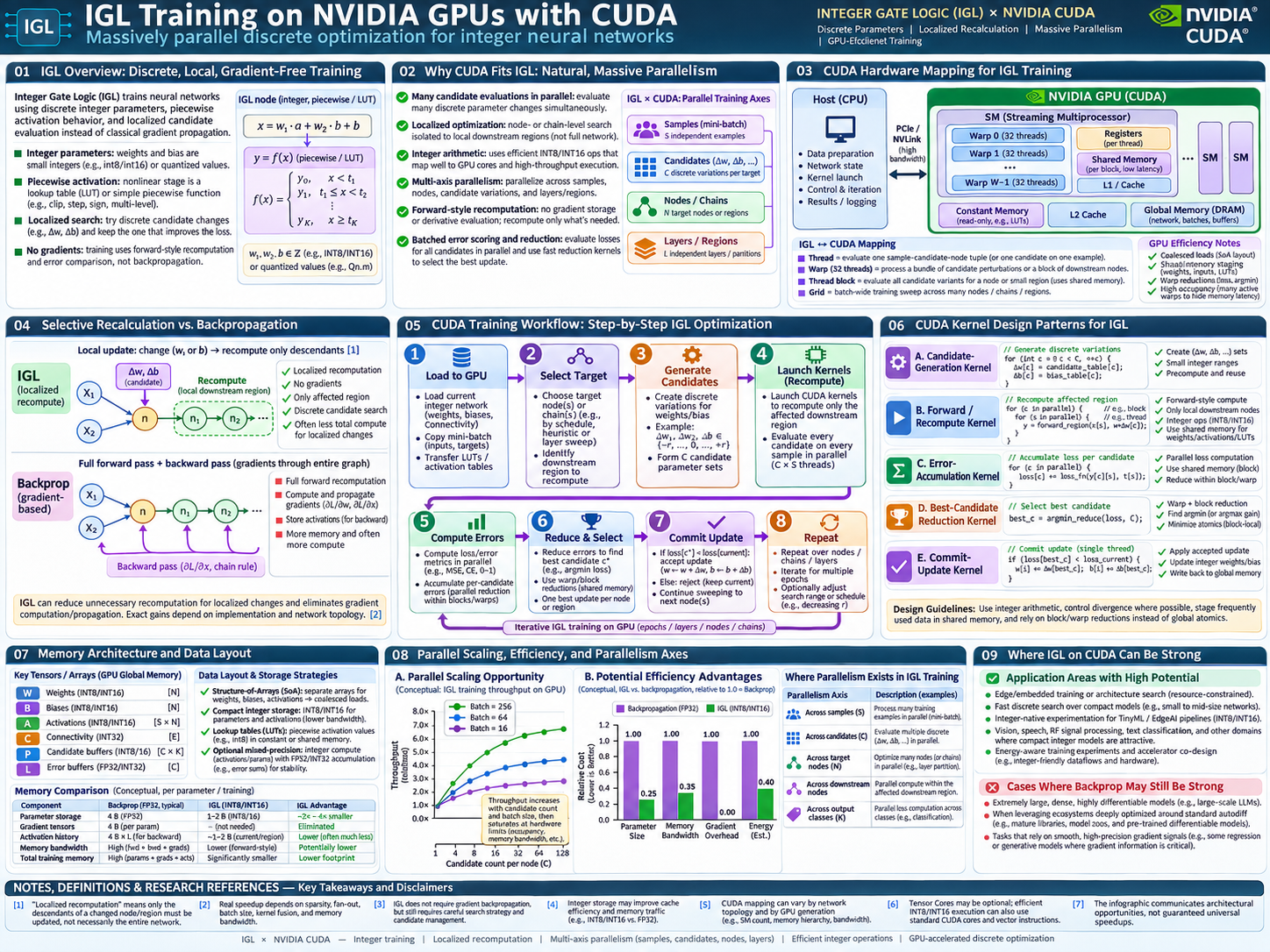
The infographic illustrates an eight-stage GPU optimization pipeline.
Stage 1 — Transfer network data to the GPU
The host CPU prepares the training batch, network parameters, connectivity information, and activation-function definitions.
These are transferred to GPU memory when required.
For repeated training iterations, frequently used model data should ideally remain resident on the GPU to minimize unnecessary PCIe or NVLink transfers.
Stage 2 — Select optimization targets
The training scheduler chooses one or more nodes, parameters, or chains for candidate evaluation.
The selection strategy may depend on network layer, node sensitivity, previous improvements, or other optimization criteria.
Stage 3 — Generate discrete candidates
Candidate changes are generated around the current integer parameter values.
The candidate set might contain small positive and negative changes, larger exploratory changes, or combinations of parameter perturbations.
Candidates may be generated on the CPU or directly on the GPU.
GPU-side generation can reduce host-device communication when candidate sets are large or frequently updated.
Stage 4 — Execute candidate recomputation
CUDA kernels evaluate the candidate parameter configurations.
Each candidate is applied to a logical copy of the relevant computational state, or to an equivalent representation that prevents candidates from interfering with one another.
Affected downstream node values are recalculated in dependency order.
Independent samples and candidates can execute concurrently.
Stage 5 — Calculate candidate errors
The output of each candidate is compared with the corresponding target values.
Depending on the task, the objective could involve classification error, squared error, a weighted loss function, or another defined performance metric.
The error calculation itself may use floating-point arithmetic even when the network parameters and node operations use integers.
Stage 6 — Reduce and compare errors
Per-sample error contributions are combined into a score for each candidate.
Parallel reduction kernels can efficiently sum the contributions across a batch.
A subsequent reduction or selection operation identifies the candidate that best satisfies the chosen objective.
Stage 7 — Commit a beneficial update
The selected change is accepted when it meets the optimization acceptance criteria.
Other candidate changes are discarded.
If an update is committed, cached values that depend on the modified parameters must be refreshed or invalidated appropriately.
Stage 8 — Repeat
The process continues over other nodes, chains, parameter groups, and training batches.
The scheduler may alter candidate-search ranges or optimization order as training progresses.
This process can be repeated until the desired stopping criteria are reached.
The architecture is compatible with CUDA kernel execution, although its ultimate efficiency depends heavily on the design of the training scheduler and memory-management system.
7. CUDA Kernel Organization for IGL
A practical GPU implementation can separate IGL training into several specialized kernel operations.
Candidate-generation kernel
This kernel produces the parameter combinations that will be tested.
For small discrete neighborhoods, candidate generation may consist of simple integer additions and bounds checking.
Forward-recomputation kernel
This kernel applies candidate values and evaluates the affected downstream computational region.
It performs weighted accumulations, activation-function calculations, and any necessary intermediate storage.
An efficient implementation should avoid repeatedly reading unchanged inputs or parameter values from slower memory when these can be reused.
Error-accumulation kernel
This kernel calculates prediction error for each candidate-sample combination.
Error contributions can be accumulated locally before being reduced into a total candidate score.
Best-candidate reduction kernel
Parallel reduction identifies the lowest-error candidate or another candidate satisfying the selected objective.
Tie-breaking behavior should be explicitly defined to support reproducible experiments.
Commit-update kernel
The selected parameter change is applied to the authoritative network state.
Appropriate synchronization ensures that subsequent evaluations use a consistent parameter configuration.
Kernel fusion
One major performance opportunity is combining operations to reduce kernel-launch overhead and intermediate memory traffic.
For example, candidate evaluation and partial error accumulation may be fused when doing so improves data locality and register utilization.
However, overly large fused kernels can increase register pressure, reduce occupancy, or introduce excessive control-flow divergence.
CUDA performance therefore requires balancing arithmetic work, memory traffic, and execution-resource utilization.
8. Memory Architecture and Efficient Data Layout
IGL training uses several categories of GPU-resident data.
These typically include:
- Integer weights and biases.
- Current node activations.
- Network connectivity information.
- Input samples and target values.
- Candidate parameter buffers.
- Intermediate candidate results.
- Error-accumulation buffers.
- Optional activation lookup tables.
Compact INT8 and INT16 representations can reduce parameter-storage requirements compared with FP32.
For the same number of stored parameters:
| Data format | Bytes per parameter | Relative raw storage |
|---|---|---|
| FP32 | 4 | 100% |
| INT16 | 2 | 50% |
| INT8 | 1 | 25% |
These ratios represent raw parameter storage only.
IGL networks may require additional connectivity indices, intermediate values, and candidate-state buffers.
Structure-of-arrays organization
CUDA memory accesses are frequently more efficient when neighboring threads access neighboring memory addresses.
A structure-of-arrays representation may help coalesce parameter and activation accesses.
For example, weights, biases, and node indices can be stored in separate contiguous arrays rather than interleaved structures.
The best layout depends on the execution mapping.
Shared-memory reuse
When many candidates operate on the same input batch or reference state, frequently reused values may be staged in shared memory.
This can reduce repeated global-memory accesses.
However, shared memory is limited, and excessive allocation per block can reduce occupancy.
Candidate-buffer management
A naive implementation might store a complete set of intermediate node activations for every candidate and every training example.
For large candidate batches, that memory requirement can become substantial.
More efficient strategies include processing candidates in tiles, retaining only necessary downstream state, and accumulating errors without storing every intermediate result.
These choices can strongly influence the maximum practical parallelism.
Training memory versus inference memory
IGL’s gradient-free optimization removes the need for conventional gradient tensors and backpropagation-specific optimizer states within its training procedure.
Nevertheless, candidate buffers and repeated forward-state calculations introduce other memory requirements.
Conventional neural-network inference also does not require backpropagation gradient storage.
Therefore, comparisons should distinguish training memory from inference memory and account for the complete working set of each implementation.
9. Parallel Scaling: When More CUDA Threads Help
The infographic illustrates how increasing candidate-level parallelism can improve GPU utilization.
A simplified candidate-evaluation workload can be represented as:
Workload ≈ C × S × D
where:
- C is the number of candidate parameter configurations.
- S is the number of training samples.
- D is the amount of downstream computation required per candidate and sample.
The expression represents computational work, not necessarily execution time.
A GPU can process many of these operations concurrently.
For small workloads, the GPU may be underutilized because there are too few independent tasks to occupy its processing resources.
Increasing the number of candidates or samples can improve utilization.
As the GPU approaches saturation, additional parallel work may provide diminishing gains in throughput.
Eventually, performance may be limited by memory bandwidth, instruction throughput, synchronization, or execution dependencies.
Important distinction: throughput versus optimization efficiency
Evaluating more candidates per second is useful, but it does not automatically mean training reaches the desired accuracy faster.
A larger search neighborhood increases the number of alternatives examined.
Whether this improves optimization efficiency depends on the probability of finding a beneficial update and the cost of evaluating the expanded search.
A rigorous study should measure both candidate-evaluation throughput and the total computational budget required to reach an accuracy target.
The scaling and efficiency charts in the infographic illustrate architectural opportunities rather than measured universal speedup factors.
10. Integer Arithmetic and NVIDIA GPU Execution Resources
IGL’s integer-valued parameters provide opportunities to use GPU integer arithmetic efficiently.
However, the implementation should be designed around the actual supported instructions and arithmetic throughput of the selected NVIDIA GPU.
Modern NVIDIA GPUs differ in their support for integer arithmetic, packed operations, and specialized matrix instructions.
Possible implementation strategies include conventional CUDA integer operations, vectorized arithmetic where suitable, and specialized acceleration when the network structure permits it.
INT8 and INT16 operations
Low-precision operands can reduce storage and memory-transfer requirements.
Intermediate accumulations may require wider data types, such as INT32, to avoid overflow.
Appropriate numerical scaling is particularly important when the activation function operates over a bounded integer range.
Tensor Cores
Tensor Cores provide high-throughput matrix operations on supported NVIDIA architectures.
They can be valuable when IGL computations can be reorganized into sufficiently regular matrix or tensor operations.
However, sparse node dependencies, irregular graph traversal, and small localized computations may not map efficiently to Tensor Core execution.
In these cases, standard CUDA kernels may be more appropriate.
Lookup-table implementations
For bounded weighted sums, activation values may be retrieved from a precomputed lookup table.
The benefit depends on table size, access locality, cache behavior, and the cost of the equivalent arithmetic implementation.
A lookup table is therefore an optimization option, not a guaranteed improvement.
11. Opportunities for Reducing GPU Memory Traffic
One of the most promising research directions is the combination of compact integer parameters and selective downstream recomputation.
In many GPU workloads, moving data between memory and arithmetic units can consume substantial time and energy.
A model that performs fewer arithmetic operations but requires many irregular memory accesses may not execute faster than a model with more arithmetic and better locality.
Consequently, IGL CUDA implementations should emphasize both computational efficiency and efficient memory access.
Potential techniques include retaining the reference network state on the GPU, batching candidate evaluations, grouping operations with similar downstream dependencies, reusing input data, and minimizing intermediate output transfers.
CUDA streams may permit overlapping independent transfers and computations when the workload and hardware support such concurrency.
The goal is to maximize useful candidate evaluations while minimizing redundant data movement.
12. Potential Advantages Over Conventional Backpropagation
IGL offers several distinctive opportunities for GPU training.
Gradient-free optimization: The training procedure does not depend on derivatives or backward gradient propagation.
Candidate-level parallelism: Multiple discrete parameter configurations can be evaluated simultaneously.
Selective recomputation: Changes to localized network regions may require recalculating only affected downstream computations.
Low-precision parameters: INT8 and INT16 storage can reduce parameter memory requirements.
Flexible nonlinear functions: Non-monotonic activation functions can be optimized through direct candidate evaluation.
Hardware-oriented implementation: Candidate generation, weighted arithmetic, loss calculations, and reduction operations can be implemented using specialized CUDA kernels.
These are meaningful architectural differences, but they should not be interpreted as proof that IGL is universally faster than backpropagation.
Conventional gradient-based methods remain highly effective, especially for large differentiable models and architectures that map efficiently to dense matrix operations.
IGL’s strongest advantages are likely to appear in applications where discrete candidate evaluations can be performed efficiently, affected downstream regions are manageable, and compact network representations provide substantial benefits.
13. Applications and Research Opportunities
CUDA-accelerated IGL training is particularly relevant to applications requiring compact integer-based models.
Embedded AI and TinyML
Models intended for deployment on microcontrollers and low-power processors can be trained on high-performance GPUs before conversion into compact embedded representations.
This allows extensive optimization without requiring the deployment device itself to perform expensive training.
RF signal classification
Radio-frequency modulation recognition involves nonlinear relationships in complex-valued signal measurements and derived signal features.
IGL networks can be trained to classify modulation characteristics and other signal patterns.
Massively parallel candidate evaluation may be useful when exploring alternative network representations and discrete parameter configurations.
Speech and acoustic classification
Compact IGL networks can be investigated for speech-command recognition, acoustic-event detection, and machinery sound classification.
GPU training can support repeated experiments across different feature representations and model architectures.
Image recognition
Handwritten-digit recognition and other compact image-classification tasks provide useful benchmarks for studying parameter efficiency and optimization behavior.
Convolutional IGL networks offer a further research direction for learning local spatial relationships.
Natural-language classification
IGL benchmark studies involving AG News and DBpedia demonstrate the relevance of compact integer architectures to text classification.
CUDA implementations could be investigated for improving optimization throughput on larger datasets or more complex network configurations.
Architecture and accelerator research
GPU-accelerated discrete optimization also creates opportunities for investigating novel network topologies, sparsity patterns, hardware-aware parameter formats, and specialized AI accelerators.
The objective is to identify architectures that achieve useful accuracy while minimizing the resources required during inference.
14. Important Engineering Challenges
Although the IGL training procedure exposes substantial parallelism, implementing it efficiently on CUDA requires addressing several important challenges.
Candidate independence: Parallel candidates must be evaluated against a consistent reference state. Their intermediate calculations must not unintentionally interfere with one another.
Network dependencies: Downstream recomputation must respect the dependency order of the computational graph.
Conflicting updates: Simultaneous parameter updates to overlapping network regions require careful coordination.
GPU occupancy: Excessive register or shared-memory usage can reduce the number of active warps.
Branch divergence: Piecewise activations and irregular graph traversal can reduce SIMD-style execution efficiency.
Search overhead: Generating and evaluating large candidate neighborhoods can consume substantial computing resources.
Memory bandwidth: Irregular activation and connectivity access may limit performance.
Numerical precision: Integer overflow, fixed-point scaling, and accumulation width must be managed explicitly.
Reproducibility: Candidate selection, parallel reductions, tie-breaking, and update ordering can influence experimental outcomes.
A successful CUDA implementation must balance all these considerations.
15. Measuring the Performance of CUDA-Accelerated IGL
The most informative GPU training studies should distinguish raw computational throughput from complete optimization performance.
Recommended measurements include:
| Performance metric | Engineering significance |
|---|---|
| Candidate evaluations per second | Measures discrete-search throughput |
| Samples processed per second | Measures batch-processing capacity |
| GPU utilization | Indicates how effectively processing resources are occupied |
| Global-memory bandwidth | Identifies memory-transfer bottlenecks |
| Kernel execution time | Measures individual operation costs |
| Candidate reduction time | Quantifies error-aggregation overhead |
| Peak GPU memory usage | Establishes training-memory requirements |
| Training time to target accuracy | Measures practical optimization efficiency |
| Total candidate evaluations | Describes the search effort required |
| Final-test accuracy | Measures predictive performance |
| GPU energy consumption | Quantifies training efficiency |
| Scaling with batch and candidate count | Reveals parallelization limits |
NVIDIA profiling tools, including Nsight Systems and Nsight Compute, can help analyze kernel behavior, occupancy, memory accesses, and execution bottlenecks.
Particularly useful experiments would compare implementations that differ in candidate batching, shared-memory staging, kernel fusion, and downstream recomputation strategy.
Controlled studies against optimized gradient-based methods should compare total training resources at equivalent accuracy targets.
16. The Broader Significance: A Different Kind of GPU Workload
Much of modern GPU-based artificial intelligence has been organized around large matrix operations and gradient computation.
IGL introduces a different training workload: the parallel evaluation of discrete candidate parameter changes across network regions and training samples.
This workload combines integer arithmetic, nonlinear activation evaluation, graph-dependent recomputation, error accumulation, and parallel candidate selection.
The architecture therefore presents opportunities for GPU optimization that extend beyond conventional neural-network training patterns.
It also raises valuable research questions.
How should thousands of discrete candidate evaluations be scheduled across Streaming Multiprocessors?
What is the best balance between candidate parallelism and sample parallelism?
How can downstream dependency graphs be organized to minimize recomputation?
When does sharing a reference activation state reduce memory traffic?
Which network structures produce the greatest benefit from localized optimization?
Can specialized kernels outperform more general GPU execution frameworks for this class of workload?
These questions provide a foundation for research into both IGL training algorithms and GPU software architecture.
Conclusion: CUDA as a Platform for Massively Parallel IGL Optimization
Integer Gate Logic offers a distinctive approach to neural-network training by replacing conventional gradient propagation with the direct evaluation of discrete parameter changes.
NVIDIA GPUs and CUDA provide a powerful platform for investigating this approach because candidate evaluations, training samples, error computations, and selected network operations can be distributed across large numbers of parallel threads.
The strongest opportunities arise from combining several architectural properties:
- Independent evaluation of candidate parameter configurations.
- Parallel processing of training examples.
- Selective recomputation of affected downstream network regions.
- Compact integer-valued weights and biases.
- GPU-based error accumulation and candidate reduction.
- Hardware-aware memory layouts and specialized CUDA kernels.
These capabilities create the potential for high-throughput discrete optimization of compact neural-network models.
The resulting performance depends on the network architecture, optimization strategy, CUDA implementation, and target GPU.
The central research objective is to determine how efficiently large numbers of independent discrete optimization experiments can be executed, and how effectively those experiments improve the accuracy of Integer Gate Logic networks.
For MLiglon Corporation, CUDA-accelerated IGL training represents an important direction for developing scalable optimization methods, exploring more sophisticated network architectures, and investigating the relationship between discrete machine-learning algorithms and massively parallel computing hardware.
The broader opportunity is to develop AI systems whose training algorithms, computational architectures, and numerical representations are designed together to exploit the capabilities of modern processors.
Patents and Technical References
U.S. Patent 12,242,946 B1 — Integer Gate Logic technology, issued March 4, 2025.
U.S. Patent 12,488,222 B1 — Additional Integer Gate Logic technology, issued December 2, 2025.
Technical platforms and concepts
- NVIDIA CUDA parallel programming architecture.
- CUDA thread, warp, block, grid, and Streaming Multiprocessor execution models.
- GPU global memory, shared memory, registers, and cache hierarchy.
- CUDA reduction algorithms and parallel candidate evaluation.
- Integer arithmetic, low-precision parameter storage, and fixed-point computation.
- Localized graph recomputation and discrete parameter optimization.
- NVIDIA Nsight Systems and Nsight Compute performance-analysis tools.
Technical Footnotes and Qualifications
[1] Localized recomputation. Only computations that can be affected by a parameter change need new values. A change to an early or highly connected node may nevertheless affect most of the downstream network.
[2] Candidate parallelism. Independent candidate evaluations can execute concurrently when they use a consistent reference state. Simultaneously committing conflicting changes requires synchronization or another conflict-resolution strategy.
[3] Gradient-free training. IGL’s discrete optimization does not require conventional backpropagation, but candidate generation, forward recomputation, loss measurement, and selection still require computational resources.
[4] Integer computation. Integer-valued weights and activations do not imply that every training operation uses integer arithmetic. Loss accumulation, candidate ranking, and other operations may use wider integers or floating-point representations.
[5] GPU architecture. CUDA execution efficiency depends on GPU generation, available arithmetic instructions, memory hierarchy, occupancy, branch divergence, and compiler optimizations.
[6] Tensor Core compatibility. Certain regularized IGL computations may map to accelerated matrix instructions, but irregular graph-based workloads may benefit more from conventional CUDA kernels.
[7] Training versus inference memory. Gradient-free optimization avoids conventional gradient storage, but IGL candidate evaluation can require significant temporary memory. Memory comparisons must include all implementation-specific buffers.
[8] Parallel scalability. Increasing the number of candidate evaluations can improve GPU utilization but also increases total computational work. Maximum candidate throughput is not equivalent to minimum time to reach target accuracy.
[9] Energy efficiency. Reduced arithmetic or memory traffic may lower training energy, but actual benefits must be established through measured execution time and power consumption.
[10] Comparative performance. The infographic describes architectural opportunities for GPU acceleration. It does not establish universal training-speed or energy-efficiency superiority over optimized backpropagation implementations.
[11] Algorithm implementation. Specific scheduling policies, candidate neighborhoods, reduction strategies, and recomputation techniques are implementation choices. The simplified workflow illustrates the computational principles rather than prescribing one complete patented training implementation.
[12] Benchmark reproducibility. Performance claims should be evaluated using documented datasets, training protocols, accuracy criteria, software versions, hardware configurations, and measurement procedures.