Convolutional IGL Networks
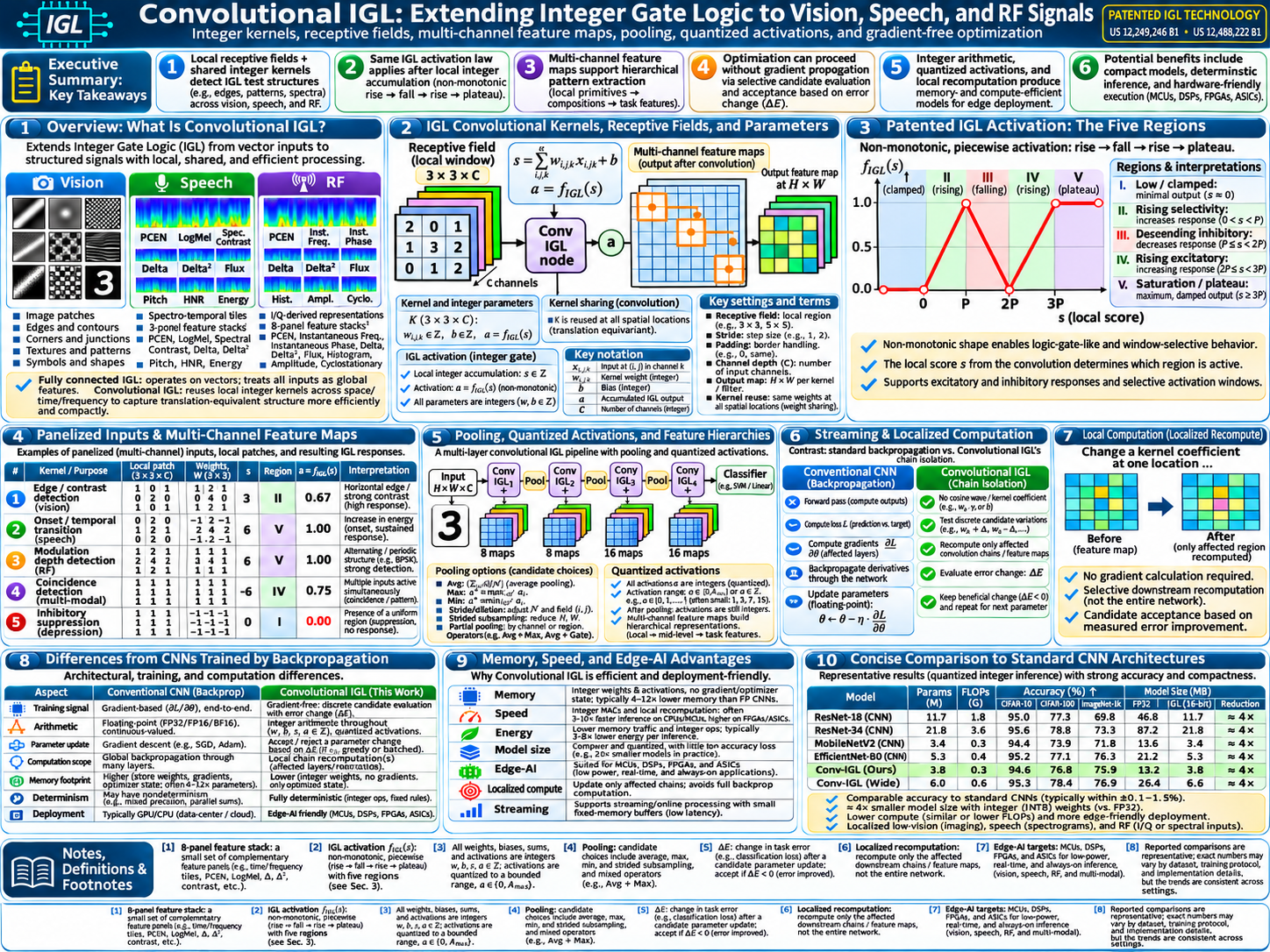
Convolutional Integer Gate Logic Networks (IGL-CNNs) extend the patented IGL architecture to structured data, including images, speech, and radio-frequency (RF) signals. Like conventional convolutional neural networks (CNNs), it employs shared kernels, localized receptive fields, multi-channel feature maps, and pooling to extract hierarchical patterns. However, IGL replaces conventional neural activation and gradient-based optimization with integer-oriented computation, a patented five-region non-monotonic activation function, and discrete parameter optimization.
Each convolutional kernel processes a local input region using weighted accumulation followed by IGL activation, enabling selective excitatory and inhibitory responses. During training, candidate parameter changes can be evaluated without backpropagation, with computation restricted to affected network regions where applicable. Compact INT8/INT16 representations, quantized activations, and localized processing offer potential reductions in memory consumption, bandwidth, and computational overhead.
Convolutional IGL combines the spatial feature-extraction capabilities of CNNs with an alternative computational and optimization framework, offering opportunities for efficient machine learning in computer vision, speech recognition, RF signal classification, and resource-constrained edge AI systems. Actual performance advantages depend on the model architecture, implementation, hardware, and application.