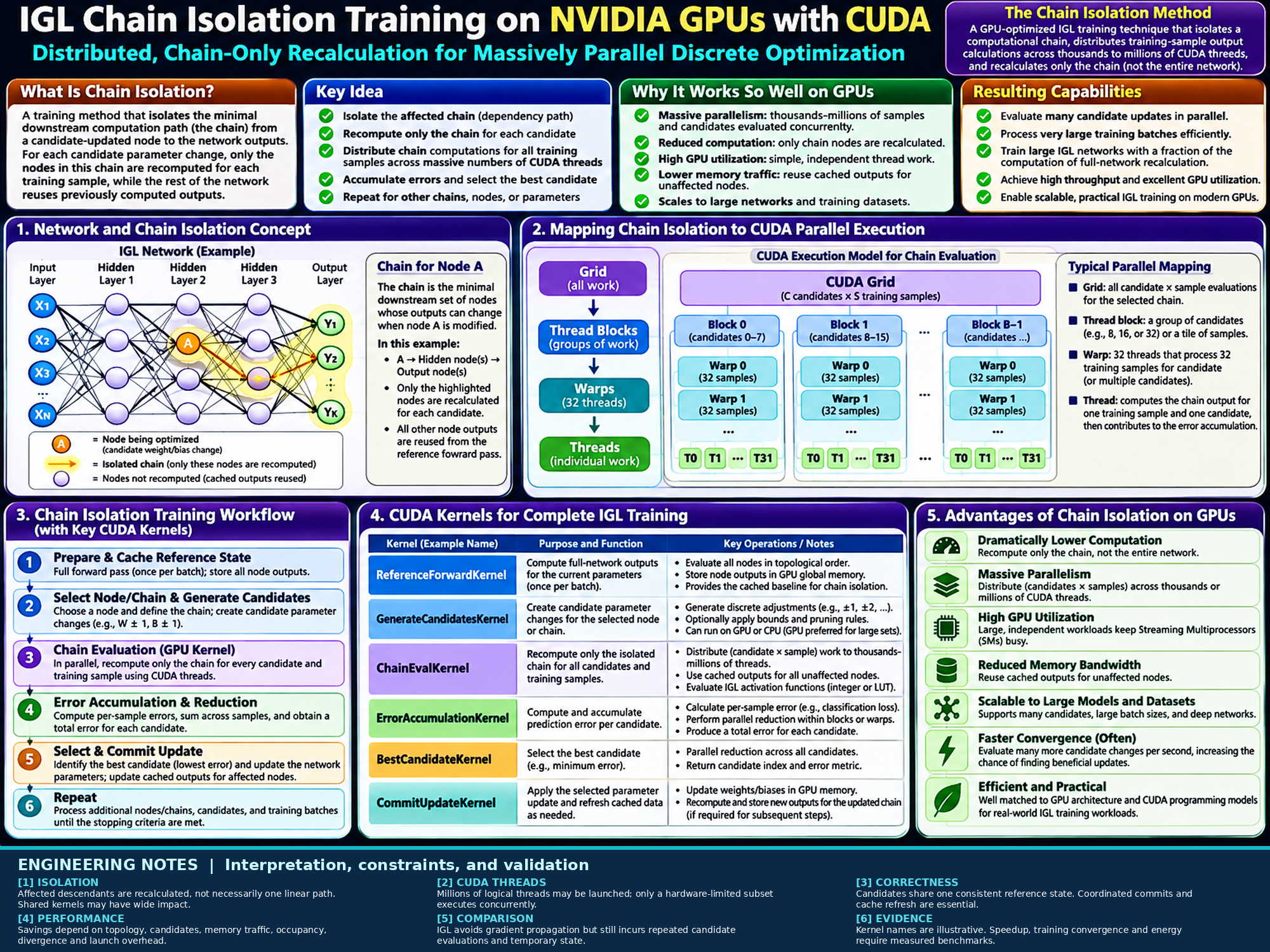
IGL Chain Isolation Training on NVIDIA GPUs Using CUDA
Massively Parallel Neural-Network Optimization Through Selective Downstream Recalculation
Modern NVIDIA graphics processing units provide enormous computational resources through thousands of arithmetic execution units, high-bandwidth memory systems, and the CUDA massively parallel programming platform.
These capabilities have traditionally been associated with training neural networks through matrix multiplication, tensor operations, and gradient backpropagation.
Integer Gate Logic (IGL), a patented machine-learning architecture developed by MLiglon Corporation, introduces a different approach to neural-network optimization: chain isolation training.
Rather than relying on gradient propagation through the entire network, chain isolation optimization evaluates discrete changes to selected node parameters and recalculates only the downstream computational dependencies affected by those changes.
When implemented on an NVIDIA GPU, the method creates opportunities to distribute large numbers of candidate evaluations and training-sample calculations across CUDA threads.
A single training operation may involve many candidate parameter configurations, each evaluated against hundreds, thousands, or potentially millions of training examples.
These evaluations can often be performed independently, allowing CUDA to schedule extremely large logical thread grids across the GPU’s available processing resources.
The essential architectural concept is:
Modify a selected node, identify the downstream computations affected by that modification, evaluate those computations across training samples and parameter candidates in parallel, and reuse all unaffected network outputs.
This approach combines three important capabilities:
- Selective computation: Recalculate the affected downstream region rather than automatically recomputing the entire neural network.
- Massive parallelism: Evaluate candidate changes and training examples concurrently using CUDA.
- Gradient-free optimization: Measure the actual error resulting from discrete parameter changes without calculating or propagating conventional loss gradients.
Together, these properties make chain isolation an interesting research direction for GPU-accelerated training of compact integer-based artificial intelligence models.
1. Understanding the Chain Isolation Principle
Consider a feedforward neural network containing multiple layers of interconnected computational nodes.
Each node receives inputs from earlier nodes, performs arithmetic operations, applies an activation function, and forwards its output to subsequent nodes.
For a basic two-input IGL node:
S = W₁X₁ + W₂X₂ + B
Y = f(S)
Here, W₁ and W₂ represent integer-valued weights, B represents an integer-valued bias, and f(S) represents the patented IGL piecewise activation function.
During training, a candidate adjustment may be proposed for one or more of these parameters.
For example, a candidate could increase W₁ by one integer unit.
The node’s output may change, and that change may influence the computations of downstream nodes.
However, it cannot influence preceding nodes or unrelated nodes that do not depend on the modified output.
This observation provides the basis for chain isolation.
The affected computational chain
In a network represented as a directed acyclic graph, the affected region consists of the selected node and its reachable downstream dependencies that contribute to the evaluated outputs.
This region may contain a simple path, multiple branching paths, or a larger subgraph.
For convenience, the term chain describes the relevant downstream computational region, even when the connectivity is not strictly linear.
An IGL implementation can isolate this region and recalculate it for each candidate change.
Other node outputs remain available from a previously computed reference state.
Reusing the reference network
At the beginning of a candidate-search operation, the current network can be evaluated against a batch of training samples.
The resulting node outputs may be cached in GPU memory.
These stored values provide a reference state.
When a selected node’s parameters are temporarily modified, unchanged upstream inputs and unrelated node outputs can be reused.
Only the affected downstream computations require new evaluation.
This can potentially eliminate substantial amounts of repeated arithmetic.
The amount saved depends on network topology, the location of the modified node, and the proportion of the network that lies downstream of that node.
2. Why Chain Isolation Can Reduce Training Computation
Consider a hypothetical network containing 20,000 computational nodes.
Suppose a particular parameter change affects only 300 downstream nodes.
A conventional full-network reevaluation would potentially involve the entire 20,000-node computation.
A selective chain evaluation could instead process the 300 affected nodes, reusing the cached values of the remaining nodes.
This illustrates a substantial reduction in computational work for that individual candidate evaluation.
However, this reduction is not guaranteed for every node.
Changes to nodes near the beginning of a densely connected network may affect most downstream computations.
Changes close to the output layer may affect only a small region.
Similarly, changing a shared convolutional parameter can influence many spatial positions, expanding the affected computation considerably.
Consequently, the computational benefit of chain isolation is determined by the actual dependency graph.
A simplified computational model
Let:
- N represent the computational work of a complete network evaluation for one sample.
- D represent the computational work of the affected downstream region.
- C represent the number of discrete parameter candidates.
- S represent the number of training samples.
Ignoring setup, caching, and reduction overhead, evaluating all candidates using complete network recomputation requires approximately:
Work(full evaluation) = C × S × N
Using isolated downstream recomputation requires approximately:
Work(chain isolation) = C × S × D
The idealized reduction factor for candidate evaluation is:
N / D
This expression describes a potential reduction in evaluated work, not an established GPU execution-time speedup.
The actual performance improvement depends on memory accesses, cache management, kernel launches, occupancy, scheduling, and the cost of maintaining a consistent reference state.
Nevertheless, when D is much smaller than N, the opportunity can be significant.
3. Why Chain Isolation Is Particularly Interesting for CUDA
CUDA is designed to execute large numbers of related operations simultaneously through GPU threads.
Chain isolation training can expose two especially useful dimensions of parallelism:
Parallelism across candidates and parallelism across training samples.
Each candidate can be evaluated independently against the same reference network parameters.
Within a candidate, different training samples can also be evaluated independently until their error contributions must be combined.
This creates a large collection of candidate-sample evaluation tasks.
Example: Thousands or millions of logical evaluations
Suppose an optimization step evaluates:
- 32 candidate parameter configurations.
- 65,536 training examples.
The resulting workload contains:
32 × 65,536 = 2,097,152 candidate-sample evaluations.
CUDA can express these evaluations through a large thread grid.
The GPU does not physically execute all two million threads at the same instant.
Instead, the CUDA runtime and hardware scheduler distribute logical threads across Streaming Multiprocessors as execution resources become available.
Many warps can be resident and execute concurrently, while additional thread blocks are scheduled as earlier work completes.
This distinction is important.
Massive CUDA parallelism means that millions of independent tasks can be scheduled efficiently—not that millions of physical GPU threads execute simultaneously.
The throughput achieved depends on the amount of computation performed by each thread, memory-access patterns, and hardware utilization.
Independent evaluations
Because each candidate-sample task can produce its own prediction or partial error, much of the computation does not require communication with other tasks.
Synchronization is primarily needed when errors are combined, candidates are ranked, or an accepted update modifies the authoritative network state.
This independence is one of the reasons the method can map naturally to CUDA.
4. Mapping Chain Isolation to the CUDA Execution Hierarchy
NVIDIA CUDA organizes parallel work through grids, thread blocks, warps, and threads.
A chain isolation implementation can map its candidate-search workload onto these structures in several ways.
| CUDA execution component | Chain isolation application |
|---|---|
| CUDA grid | Represents the complete candidate-evaluation workload |
| Thread block | Processes a tile of samples, candidates, or affected nodes |
| Warp | Executes coordinated groups of 32 threads |
| Thread | Evaluates one or more candidate-sample tasks |
| Registers | Store weighted sums, temporary values, and local errors |
| Shared memory | Cache reused inputs, candidate parameters, and partial reductions |
| Global memory | Store training examples, network state, connectivity, and results |
| Reduction kernel | Combine error contributions and select favorable candidates |
Candidate-major execution
One mapping assigns thread blocks to candidate configurations.
Within each block, threads process different training samples.
This allows candidate parameters to be reused across many sample evaluations.
Sample-major execution
Another mapping assigns blocks to batches of training samples.
Threads or groups of threads then evaluate multiple candidate configurations for those samples.
This can improve reuse of input data and reference activations.
Tiled execution
For larger networks or candidate sets, a tiled design can combine both strategies.
Each block processes a manageable group of candidates and training examples.
This reduces temporary memory requirements while providing enough parallel work to occupy the GPU.
The best mapping is not universal.
It depends on the number of candidates, training batch size, affected-chain length, node connectivity, and the characteristics of the target GPU.
5. The Complete Chain Isolation Training Workflow
The infographic illustrates a six-stage training methodology.
Stage 1 — Prepare and cache the reference state
The current IGL network is evaluated against the selected training batch.
The resulting node outputs are stored where they can be reused.
This establishes a consistent reference state for evaluating candidate changes.
The reference calculations may be performed using one or more CUDA kernels.
Stage 2 — Select a node or chain and generate candidates
The optimization scheduler selects the parameter or group of parameters to be investigated.
Candidate changes might include increasing or decreasing a weight or bias by one or more discrete units.
Each candidate represents a temporary alternative to the current parameter configuration.
The authoritative network parameters remain unchanged while candidates are evaluated.
Stage 3 — Evaluate the isolated chain
CUDA threads evaluate each candidate against assigned training samples.
The computation begins at the modified node and proceeds through the affected downstream dependencies.
Unchanged node outputs are read from the reference cache.
The relevant network outputs are then calculated for each candidate-sample combination.
Stage 4 — Accumulate prediction errors
The resulting predictions are compared against the training targets.
Each candidate receives error contributions from the samples used in its evaluation.
These contributions are combined using appropriate parallel reduction operations.
Stage 5 — Select and commit the preferred update
The candidate scores are compared.
An update is accepted if it satisfies the selected optimization criteria.
For example, an implementation may accept the candidate that produces the lowest aggregate training error, provided it improves on the reference configuration.
If no candidate meets the criteria, the original parameters can be retained.
Stage 6 — Repeat across the network
The optimization process moves to additional nodes, parameter groups, or chains.
Reference activations are refreshed or invalidated as necessary after accepted changes.
The procedure continues according to the training schedule and stopping criteria.
This workflow illustrates the central operations involved in GPU-based chain isolation optimization.
Specific implementations may fuse stages, use different scheduling strategies, or evaluate more complex parameter neighborhoods.
6. CUDA Kernels Required for Chain Isolation Training
A practical implementation can organize the training procedure around six principal kernel functions.
The names below are illustrative CUDA implementation names rather than mandatory components of the patented method.
Kernel 1 — ReferenceForwardKernel
Purpose: Establish a reusable reference network state.
This kernel evaluates the current network against a batch of training samples.
It records the node outputs needed for subsequent candidate evaluations.
Typical responsibilities include:
- Loading the current integer weights and biases.
- Evaluating weighted sums and activation functions.
- Respecting network dependency order.
- Storing selected intermediate outputs.
- Producing the current network predictions.
For feedforward networks, nodes at the same dependency level may be processed concurrently.
The reference state can be retained across candidate evaluations as long as its underlying parameters remain valid.
The engineering objective is to calculate unchanged outputs once and reuse them many times.
Kernel 2 — GenerateCandidatesKernel
Purpose: Construct discrete parameter alternatives.
This kernel generates candidate changes for the selected node or chain.
For a two-input node, a simple search neighborhood might include:
- W₁ − 1 and W₁ + 1.
- W₂ − 1 and W₂ + 1.
- B − 1 and B + 1.
Larger candidate sets may explore additional adjustment magnitudes or simultaneous parameter changes.
The kernel must enforce the permitted integer ranges and any constraints imposed by the IGL architecture.
Candidate generation can also incorporate prior search information or scheduling rules.
For simple candidate neighborhoods, generation may require very little computation and can sometimes be combined with the evaluation kernel.
Kernel 3 — ChainEvalKernel
Purpose: Recalculate the affected downstream region for each candidate and sample.
This is the central computational kernel in the proposed architecture.
The kernel receives a candidate configuration, the associated training sample, and the reference network state.
It then evaluates the modified node and the downstream computations affected by that modification.
Inputs and outputs outside the affected region are reused from the reference cache.
A simplified computational description is:
For each candidate and training sample:

    Load candidate parameter values
    Load cached upstream and unaffected outputs

    Evaluate the modified node

    For each downstream dependency level:
        Recalculate affected nodes
        Reuse unaffected node outputs

    Produce the candidate prediction
Candidate-sample combinations can be distributed across CUDA threads or groups of threads.
Within each combination, node dependencies still require the correct execution order.
The affected region may be a branching subgraph rather than a single linear path.
The implementation must also prevent one candidate’s temporary values from overwriting another candidate’s state.
Efficient management of these temporary values is essential for achieving high throughput.
Kernel 4 — ErrorAccumulationKernel
Purpose: Calculate and combine the prediction error for each candidate.
After candidate predictions have been computed, each prediction must be compared with its corresponding target.
The error metric may be classification-specific or based on another defined objective.
Examples include squared error, absolute error, weighted classification losses, or other metrics appropriate to the training task.
For each candidate, the kernel combines errors across the selected training samples.
CUDA reduction techniques can perform this operation efficiently.
Possible approaches include:
- Per-thread partial error accumulation.
- Warp-level reductions.
- Shared-memory block reductions.
- Additional reduction passes across thread blocks.
Accumulation order and numerical representation should be selected carefully.
Although IGL node parameters may use INT8 or INT16, training-error calculations may use wider integer or floating-point arithmetic.
Kernel 5 — BestCandidateKernel
Purpose: Identify the preferred parameter adjustment.
This kernel examines the aggregate error associated with each candidate.
It selects the candidate satisfying the specified optimization rule.
For example, it may identify the minimum-error candidate or a candidate that provides sufficient improvement over the existing parameters.
Candidate selection can be performed using parallel reduction techniques.
The kernel may return:
- The selected candidate index.
- The candidate’s aggregate error.
- The improvement relative to the reference model.
- An acceptance or rejection decision.
A deterministic tie-breaking rule can help make training experiments reproducible.
Kernel 6 — CommitUpdateKernel
Purpose: Apply an accepted parameter change and maintain a consistent network state.
Once the preferred candidate has been selected, its parameter changes can be committed to the authoritative network.
The kernel may update weights, biases, and associated metadata.
Cached outputs affected by the update must also be refreshed or marked invalid before subsequent dependent evaluations.
If the candidate is rejected, the original network parameters remain unchanged.
Where multiple independent chains are optimized concurrently, accepted updates must be coordinated to avoid conflicting modifications or inconsistent reference states.
In many implementations, separate CUDA kernel launches provide the synchronization boundaries between candidate evaluation, reduction, selection, and update commitment.
This helps maintain correct ordering across thread blocks.
7. Additional Supporting CUDA Operations
The six kernels above describe a useful conceptual architecture, but a production implementation may benefit from additional specialized operations.
Dependency-analysis and chain-selection operations
These identify the downstream nodes affected by each selected parameter.
For a fixed network topology, dependency information can often be calculated in advance rather than rediscovered for every candidate.
Cache-refresh operations
After a parameter update, cached activations belonging to affected nodes may need to be updated.
This helps preserve the consistency of future candidate evaluations.
Input-preprocessing kernels
Applications involving speech, images, vibration, or RF signals may require substantial feature extraction before IGL evaluation.
Such preprocessing may also be accelerated using CUDA.
Batch-management operations
Training datasets may be divided into batches or tiles to control GPU memory consumption.
Batch-management logic helps maintain adequate GPU utilization without allocating excessive temporary storage.
Validation and metric-aggregation operations
Separate evaluation kernels can calculate validation accuracy, classification statistics, or stopping criteria.
These operations are distinct from candidate selection and can be performed periodically rather than after every parameter update.
8. A Major Advantage: Reusing Previously Calculated Outputs
One of the defining opportunities of chain isolation is the reuse of intermediate node outputs.
Consider a candidate modification to a node in the middle of a network.
The input layers and unaffected earlier computations do not need to be reevaluated for that candidate.
Likewise, unrelated branches of the network retain their reference values.
The chain evaluation accesses these cached values as needed.
Benefits of caching
Less redundant arithmetic: Computations unrelated to the parameter change can be skipped.
Lower repeated memory traffic: Frequently reused values may remain in GPU caches or appropriately organized buffers.
Faster candidate evaluation: When the affected region is small, each candidate can require substantially less work than a full forward pass.
Better batching opportunities: Many candidates can share a common reference state.
Costs of caching
Caching introduces its own engineering requirements.
Stored activations consume GPU memory.
Candidate changes may require temporary output buffers.
Accepted updates can invalidate reference values.
The implementation must manage these resources without creating excessive memory traffic or synchronization overhead.
Therefore, the appropriate comparison is the net computational cost after accounting for caching and temporary storage, not merely the number of nodes skipped.
9. Parallelizing Across Very Large Training Datasets
IGL chain isolation can naturally distribute computations across training examples.
A selected candidate produces predictions independently for each sample until the aggregate error must be calculated.
This permits the training workload to be divided among many CUDA threads.
Large-batch evaluation
Large training batches provide substantial independent work.
For each candidate, the GPU can process many samples simultaneously.
The corresponding errors can then be combined through reduction operations.
Candidate batching
If the candidate count is also large, the computation can be divided along both dimensions.
For example, blocks may process groups of candidate configurations against groups of samples.
The resulting candidate scores are combined in subsequent reductions.
Streaming and tiling
A dataset containing millions of training samples does not necessarily need to reside entirely in GPU memory.
Samples can be processed in batches, with partial error accumulations combined across batches.
This enables evaluation of large datasets even when their complete contents exceed available GPU memory.
The implementation must ensure that the accumulated objective remains consistent with the intended training procedure.
GPU utilization
Large numbers of independent candidate-sample evaluations can help maintain GPU utilization.
However, very short kernels, irregular memory accesses, long dependency chains, and synchronization overhead can still limit throughput.
Efficient scheduling and kernel design remain essential.
10. Chain Isolation Versus Conventional Backpropagation
Chain isolation and gradient backpropagation differ in their mathematical objectives and computational organization.
| Characteristic | IGL chain isolation | Conventional backpropagation |
|---|---|---|
| Parameter optimization | Direct discrete candidate evaluation | Gradient-based updates |
| Gradient computation | Not required | Required |
| Activation differentiability | Not required | Generally needed for standard backpropagation |
| Candidate evaluation | Potentially many alternatives | Typically one gradient update from a batch |
| Recalculation | Affected downstream dependencies | Forward and backward operations |
| Parallelism | Samples, candidates, independent regions | Samples, tensors, matrix operations |
| Intermediate storage | Reference activations and candidate state | Activations, gradients, optimizer state |
| Hardware optimization | Discrete search, graph reuse, reductions | Dense linear algebra, fused kernels, Tensor Cores |
| Principal challenge | Search efficiency and dependency management | Gradient computation and optimization behavior |
A particularly important difference concerns the cost of a parameter update.
Backpropagation can calculate gradients for many parameters using one backward pass.
Discrete candidate optimization may need to evaluate many alternatives to identify beneficial changes.
Therefore, an individual chain evaluation may be less expensive than a complete forward-and-backward pass, but the number of candidate evaluations required to achieve a target accuracy may be much larger.
The correct engineering comparison is the total training time, computational work, memory use, and energy required to reach comparable predictive accuracy.
Chain isolation should not be interpreted as a universal replacement for backpropagation.
Its potential advantages are most compelling when parameter changes affect relatively small downstream regions and many candidate evaluations can be executed efficiently in parallel.
11. GPU Memory Architecture and Optimization Strategies
Modern NVIDIA GPUs provide multiple memory levels with different capacities and access costs.
Efficient chain isolation training should organize data to exploit this hierarchy.
Registers
Registers are suitable for frequently accessed local values, such as weighted sums, candidate parameters, and intermediate activation values.
Excessive register usage can reduce active warp occupancy.
Shared memory
Shared memory allows threads within a block to reuse data efficiently.
Training samples, candidate parameters, and selected cached values may be staged here when reuse justifies the allocation.
L1 and L2 caches
GPU caches can reduce the cost of repeated access to network parameters and reference activations.
Compact integer representations may improve cache residency.
Global memory
Large arrays containing training examples, network parameters, reference activations, connectivity indices, and candidate buffers generally reside in GPU global memory.
Memory layouts should favor coalesced access wherever practical.
Compact integer storage
IGL’s use of integer-valued parameters can reduce the size of model data.
For equal parameter counts, INT8 storage occupies one-quarter the raw space of FP32 storage.
INT16 occupies one-half.
These reductions can decrease memory-transfer requirements, although chain-isolation implementations may also need connectivity metadata and temporary candidate buffers.
Avoiding unnecessary temporary storage
A naive implementation might allocate a complete output buffer for every candidate and training example.
For large candidate sets, this could consume excessive memory.
More efficient implementations can use tiled candidate evaluation, compact chain-local buffers, and immediate accumulation of error contributions.
These techniques can reduce memory pressure while preserving substantial parallelism.
12. Architectural Advantages of Chain Isolation on GPUs
The infographic identifies several areas in which chain isolation may be advantageous.
Reduced computation
When an update influences only a small portion of the network, the method can avoid evaluating unaffected nodes.
This reduces arithmetic work per candidate evaluation.
Massive parallelism
Independent candidate and sample evaluations create a large supply of CUDA tasks.
This can help occupy many Streaming Multiprocessors.
High candidate-evaluation throughput
A well-optimized implementation may evaluate many discrete parameter alternatives per second.
This can support more extensive parameter searches within a given training period.
Reduced redundant memory movement
Reusing reference activations can eliminate repeated calculations and associated memory accesses.
The actual benefit depends on cache organization and how efficiently the isolated region is represented.
Scalability across datasets
Candidate evaluations can be performed across large batches or streamed datasets.
This allows the architecture to exploit GPU parallelism without requiring every training example to reside in GPU memory simultaneously.
Compatibility with integer-oriented computation
IGL nodes can employ INT8 and INT16 parameters with appropriately sized accumulators.
This creates opportunities to exploit low-precision arithmetic and compact memory representations.
Flexibility in optimization strategy
The discrete-search procedure can investigate candidate adjustments of different magnitudes or combinations without requiring activation derivatives.
This allows the training algorithm to explore non-monotonic parameter-response relationships.
13. Important Limits and Engineering Considerations
Chain isolation has substantial architectural potential, but several issues determine its practical effectiveness.
Chain size: The affected downstream region may be large in dense or highly connected networks.
Shared parameters: Updating a convolutional kernel can affect many node outputs across a feature map.
Candidate count: Large search neighborhoods increase computational work even when each candidate is inexpensive.
Memory pressure: Candidate-local buffers and reference activations can consume substantial GPU memory.
Branch divergence: Different threads may follow different activation regions or graph paths.
Synchronization: Candidate selection and accepted parameter updates must preserve a consistent network state.
Scheduling efficiency: Excessively small GPU kernels may incur significant launch overhead.
Numerical correctness: Integer overflow, scaling, and wider accumulation must be managed carefully.
Training convergence: High candidate-evaluation throughput does not guarantee rapid convergence to an accurate model.
Comparison methodology: Any claimed advantage should be evaluated against optimized conventional implementations under comparable accuracy requirements.
These issues are central to developing a production-quality CUDA chain isolation training system.
14. Opportunities for Further CUDA Optimization
Several advanced implementation strategies deserve investigation.
Fused evaluation and error kernels
Candidate recomputation and partial error calculation may be combined to reduce kernel launches and intermediate memory writes.
Graph-aware work scheduling
Nodes with similar downstream dependency structures can be grouped together.
This may improve data reuse and reduce control-flow divergence.
Adaptive candidate batching
The number of candidates evaluated concurrently can be adjusted according to chain size, batch size, and available GPU memory.
Multi-level reduction
Warp-level, block-level, and grid-level reductions can efficiently combine candidate error statistics.
Overlapping computation and transfers
CUDA streams may permit data movement and independent computation to overlap, reducing idle time in suitable workloads.
Multiple-GPU training
Candidate evaluations or partitions of training samples may be distributed across multiple GPUs.
Each GPU could evaluate a subset of the candidate-sample workload, with aggregate errors combined before selecting accepted updates.
The communication required for shared network parameters and reductions would need to be managed carefully.
Hardware-aware search scheduling
The optimization algorithm could prioritize candidate groups or network regions that provide favorable ratios of expected improvement to computational cost.
This offers a potential connection between machine-learning optimization and GPU resource scheduling.
15. Measuring the Performance of Chain Isolation Training
To establish its practical advantages, a CUDA chain isolation implementation should be evaluated using reproducible performance measurements.
| Measurement | Purpose |
|---|---|
| Candidate evaluations per second | Measures discrete-search throughput |
| Training samples evaluated per second | Measures sample-processing capacity |
| Average affected-chain size | Quantifies selective recomputation |
| Nodes evaluated per candidate | Measures actual computational work |
| Cache reuse ratio | Estimates benefit from reused node outputs |
| Kernel execution time | Identifies computational bottlenecks |
| Candidate-reduction time | Measures error-aggregation overhead |
| Peak GPU memory | Establishes training resource requirements |
| GPU memory bandwidth | Identifies data-movement limitations |
| SM utilization and occupancy | Measures hardware utilization |
| Time to target validation accuracy | Measures practical training efficiency |
| Final-test accuracy | Establishes predictive performance |
| Energy to target accuracy | Measures total training energy efficiency |
Profiling tools such as NVIDIA Nsight Systems and Nsight Compute can help identify inefficient memory accesses, thread divergence, occupancy limitations, kernel-launch overhead, and synchronization costs.
These measurements are necessary to determine whether the expected architectural advantages translate into meaningful reductions in actual training cost.
16. Where Chain Isolation Training May Be Most Effective
Chain isolation is particularly promising for network structures and training problems possessing several favorable characteristics.
Sparse connectivity: A parameter change affects a relatively limited set of downstream computations.
Moderate chain depth: The isolated dependency region can be evaluated efficiently.
Large training batches: Many samples can be evaluated concurrently.
Multiple candidate configurations: Discrete search provides abundant independent work.
Compact integer models: Parameter and activation representations fit efficiently within GPU memory and caches.
Repeated candidate evaluation: A cached reference state can be reused across many alternatives.
Potential application areas include compact neural-network training for embedded AI, TinyML, industrial classification, acoustic-event recognition, RF modulation classification, machine vision, and natural-language classification.
Training may occur on a powerful GPU even when the resulting model is intended for deployment on a much smaller microcontroller or DSP.
This separation allows extensive optimization to be performed using substantial GPU resources while keeping the final inference model compact.
17. The Broader Research Opportunity
The most significant implication of chain isolation is that it changes the organization of the neural-network training workload.
Conventional GPU training is commonly built around large differentiable tensor operations.
Chain isolation instead emphasizes discrete experimentation, selective graph recomputation, candidate-level parallelism, and direct evaluation of the resulting prediction error.
The GPU becomes a massively parallel engine for evaluating parameter alternatives.
This creates several important research questions:
- How should candidate-search neighborhoods be distributed across GPU threads?
- What reference-state caching strategies provide the greatest reduction in repeated computation?
- How can affected downstream regions be represented efficiently?
- When should candidate evaluation use one thread per sample versus groups of cooperating threads?
- How can candidate selection and parameter commitment avoid unnecessary synchronization?
- Which network architectures provide the most favorable isolation characteristics?
- How does chain isolation training scale with increasing model depth, candidate count, and dataset size?
- How does total training energy compare with optimized gradient-based learning methods at equivalent accuracy?
Answering these questions could lead to new GPU training algorithms, scheduling techniques, and hardware-aware optimization strategies for discrete machine-learning systems.
Conclusion: Training by Recalculating Only What Changes
Integer Gate Logic chain isolation training provides an alternative computational framework for neural-network optimization.
Its central insight is straightforward:
When a candidate parameter change affects only a limited downstream region, there is no need to recompute unrelated network outputs for that candidate.
By caching the current network state and selectively evaluating affected dependencies, chain isolation can reduce redundant computation.
NVIDIA CUDA extends this approach by allowing large numbers of candidate parameter changes and training samples to be evaluated concurrently.
The complete training method can be organized around reference-state computation, candidate generation, isolated chain evaluation, error accumulation, candidate selection, and parameter commitment.
These operations can be implemented through specialized CUDA kernels designed around integer arithmetic, memory reuse, and parallel reductions.
The resulting architecture presents opportunities for high-throughput discrete optimization, especially in compact or sparsely connected neural networks.
Actual performance advantages must be established through controlled GPU benchmarks, including comparisons of total training time, memory usage, energy consumption, and predictive accuracy.
For MLiglon Corporation, GPU-accelerated chain isolation represents a significant research direction for developing efficient, scalable, gradient-free optimization methods for Integer Gate Logic networks.
The larger opportunity is to combine algorithmic innovation with modern GPU architecture to make discrete neural-network training increasingly practical across a broad range of artificial intelligence applications.
Patents and Technical References
U.S. Patent 12,242,946 B1 — Integer Gate Logic technology, issued March 4, 2025.
U.S. Patent 12,488,222 B1 — Additional Integer Gate Logic technology, issued December 2, 2025.
Related computing technologies
- NVIDIA CUDA parallel computing platform.
- CUDA thread, warp, block, and grid execution models.
- Streaming Multiprocessor execution and GPU occupancy.
- GPU global memory, shared memory, and register allocation.
- Parallel reduction and candidate-selection algorithms.
- Sparse computational graphs and dependency-based recomputation.
- Low-precision integer arithmetic and fixed-point computing.
- NVIDIA Nsight Systems and Nsight Compute profiling tools.
Technical Footnotes and Qualifications
[1] Definition of a chain. In this discussion, an isolated chain includes the affected downstream dependencies of a modified node. This may be a branching subgraph rather than a single linear sequence.
[2] Cached reference values. Reuse is valid only when the cached values correspond to the network state against which the candidate is evaluated. Accepted changes may require cache updates or invalidation.
[3] Parallel CUDA execution. CUDA supports grids containing millions of logical threads, but only a hardware-dependent subset can execute concurrently. Remaining work is scheduled as processing resources become available.
[4] Candidate independence. Different parameter candidates can be evaluated independently against a common reference state. Concurrently committing conflicting changes requires explicit coordination.
[5] Reduced computation. Chain isolation can avoid recomputation of unaffected nodes, but its benefits depend on topology, update location, graph fan-out, and parameter sharing.
[6] Kernel definitions. The six named kernels are illustrative implementation components. Actual CUDA software may combine, divide, or reorganize these functions for performance.
[7] Gradient-free optimization. Chain isolation does not require conventional loss-gradient backpropagation, but repeated candidate evaluations may still entail substantial computational cost.
[8] Numerical precision. INT8 or INT16 parameters do not require all training operations to use the same precision. Accumulators and error calculations may use wider integer or floating-point types.
[9] Memory efficiency. Cached activations and candidate buffers create additional memory requirements. Total training memory must be measured rather than inferred solely from parameter-storage precision.
[10] Speed and convergence. Higher candidate-evaluation throughput does not automatically imply faster convergence or lower total training cost.
[11] GPU efficiency. Performance depends on GPU generation, CUDA implementation, occupancy, memory bandwidth, thread divergence, and synchronization overhead.
[12] Comparative results. The infographic illustrates architectural capabilities and potential advantages of chain isolation. It does not establish universal training-speed or energy-efficiency superiority over optimized backpropagation.
[13] Patent scope. The simplified kernel organization and workflow are explanatory engineering examples. The legal scope of patented inventions is defined by the issued patent claims, not by this overview.
[14] Reproducibility. Claims of performance improvement should be supported by documented hardware, software versions, datasets, candidate-search procedures, accuracy criteria, and measurement methodologies.