Integer Gate Logic Benchmark Results: Accuracy, Memory, and Computational Efficiency
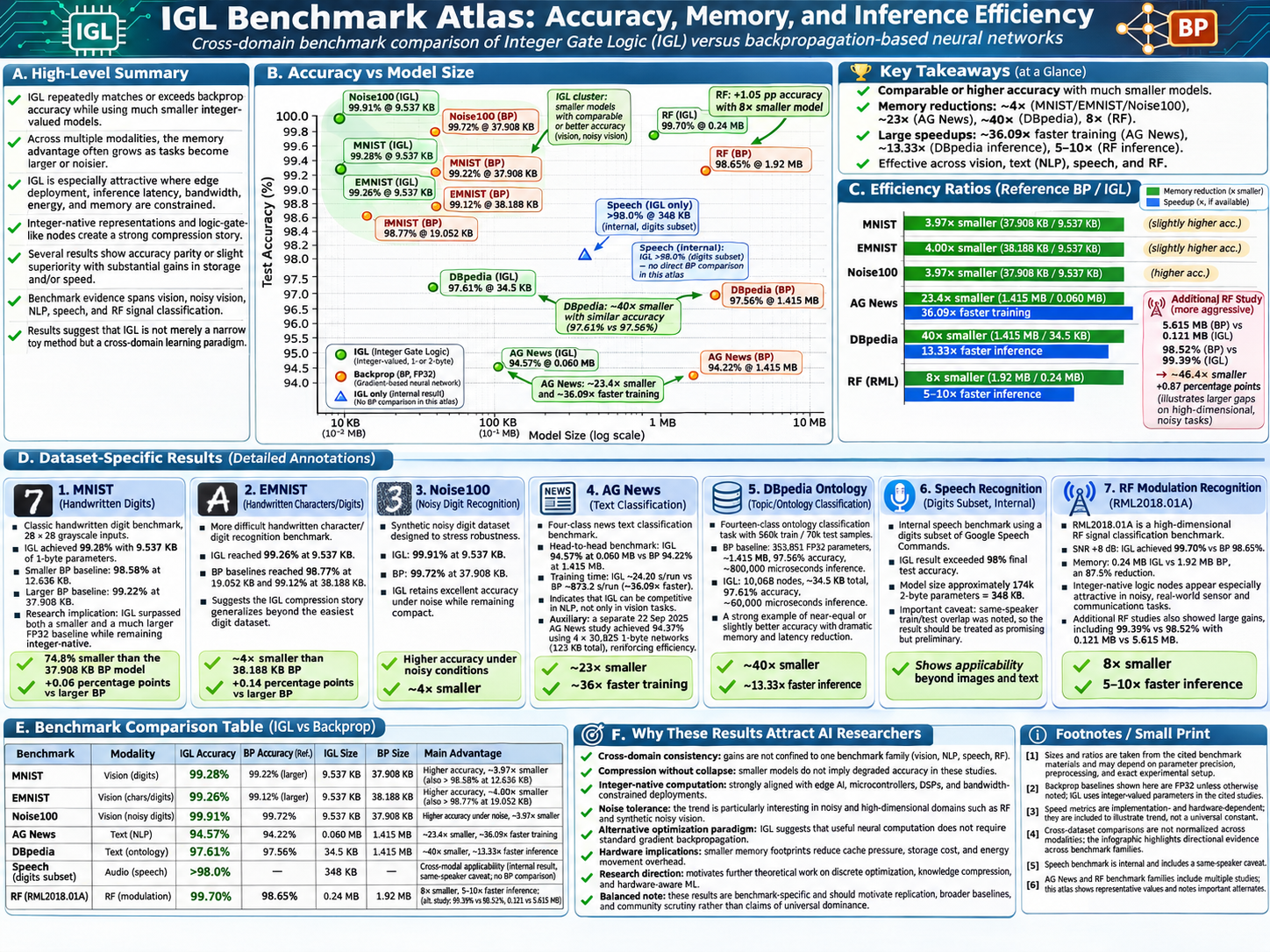
MLiglon Corporation has evaluated its patented Integer Gate Logic (IGL) architecture against conventional backpropagation-trained neural networks across multiple machine-learning benchmarks, including handwritten-character recognition, natural-language classification, synthetic noisy-image recognition, and RF modulation classification.
The reported results demonstrate that IGL can achieve competitive or higher classification accuracy with substantially smaller parameter representations. On MNIST, IGL achieved 99.28% test accuracy using only 9.537 KB of one-byte parameters, compared with 99.22% accuracy and 37.908 KB for the FP32 baseline. On AG News, IGL achieved 94.57% accuracy with approximately 60 KB of parameters, representing a 23.4-fold reduction in parameter storage relative to the tested baseline.
The DBpedia benchmark demonstrated particularly notable efficiency: 97.61% accuracy using 35,408 bytes, compared with 97.56% accuracy using 1,415,404 bytes for the PyTorch baseline. The experiment also reported approximately 40× smaller parameter storage and 13.3× faster inference under its evaluation conditions.
These results illustrate the potential advantages of IGL’s compact integer-valued parameters, nonlinear logic-capable nodes, and alternative computational architecture for resource-constrained artificial intelligence.
Technical note: All comparisons reflect specific experimental configurations, datasets, and evaluation procedures. Reported model sizes primarily represent parameter storage rather than complete runtime memory. Performance improvements are benchmark-specific and should not be interpreted as universal advantages over optimized quantized neural networks.