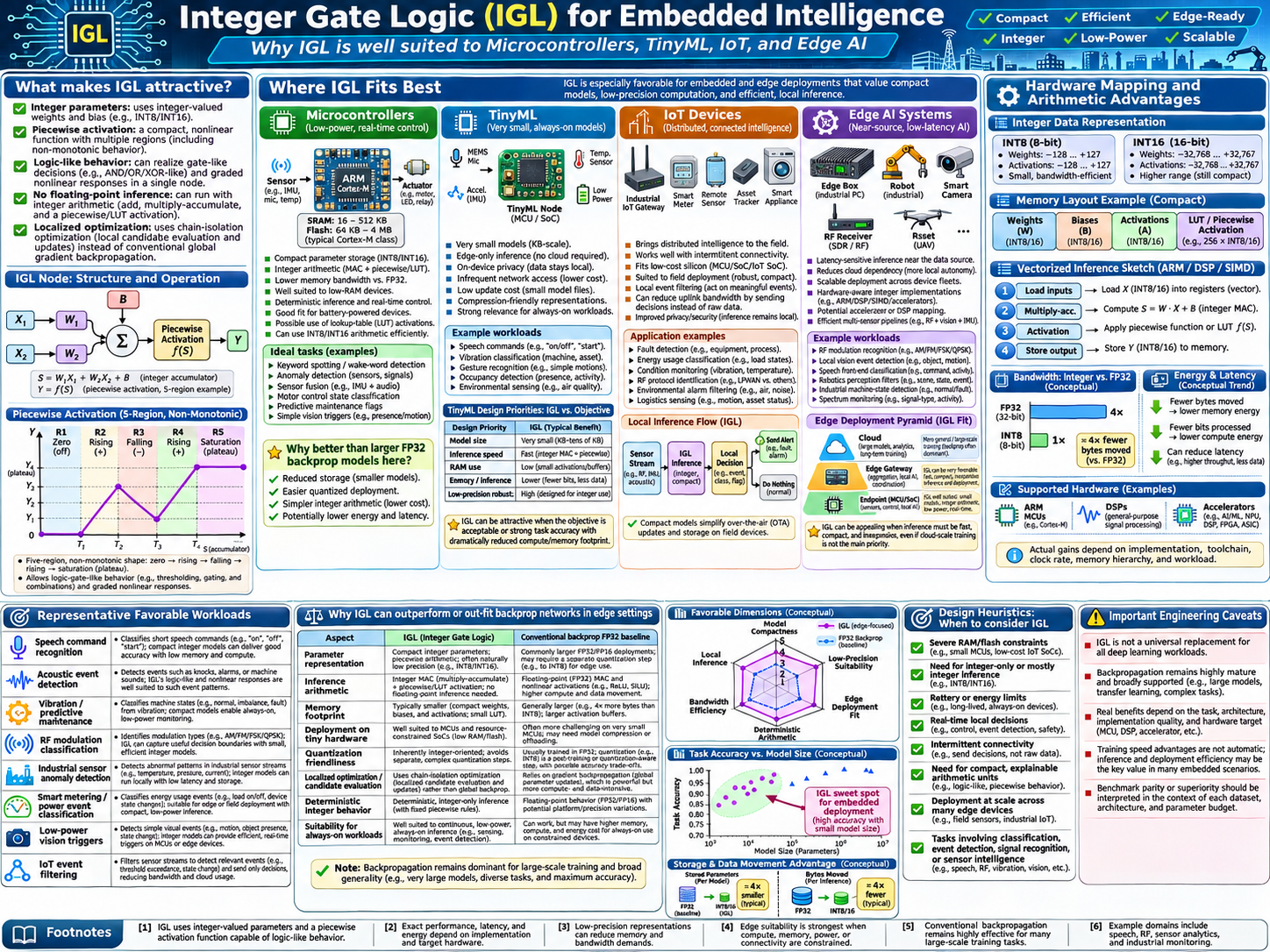
Integer Gate Logic for Microcontrollers, TinyML, IoT, and Edge AI
Bringing Advanced Artificial Intelligence to Resource-Constrained Computing Systems
Integer Gate Logic (IGL) is a patented machine-learning architecture developed by MLiglon Corporation that offers a promising alternative to conventional floating-point neural networks for embedded artificial intelligence.
Its defining characteristics—including compact integer-valued parameters, logic-emulating activation functions, discrete optimization, and the potential for efficient lookup-table execution—make IGL particularly attractive for applications where processing power, memory capacity, electrical energy, and communication bandwidth are limited.
Traditional AI development has often emphasized increasingly large models executed on powerful GPUs, cloud servers, and specialized AI accelerators. However, many practical engineering applications have very different requirements.
An industrial sensor may need to identify abnormal vibration patterns using only a few kilobytes of available memory. A battery-powered wireless device may need to recognize events while consuming minimal electrical power. A robotic controller may need deterministic decisions within milliseconds. An RF receiver may need to distinguish modulation patterns without continuously transferring raw signal data to a remote processor.
For these applications, the objective is not necessarily to deploy the largest possible neural network.
The objective is to achieve the required prediction accuracy with the smallest practical computational footprint, lowest achievable latency, and minimum energy consumption.
IGL has been designed to investigate precisely this class of machine-learning problems.
Its benchmark results suggest that carefully constructed integer-native networks can achieve highly competitive classification accuracy while requiring substantially less parameter storage than selected conventional backpropagation-trained FP32 neural networks.
These characteristics create important opportunities across four related application areas: microcontrollers, TinyML, the Internet of Things, and Edge AI.
1. Why IGL Is Attractive for Embedded Artificial Intelligence
Embedded computing systems operate under constraints that differ significantly from those of data-center environments.
A cloud-based AI system may have access to gigabytes of memory, high-performance processors, and extensive electrical power. By contrast, an embedded system may have tens or hundreds of kilobytes of SRAM, limited Flash storage, modest processing throughput, and stringent real-time requirements.
A machine-learning architecture suitable for these environments must address several engineering challenges simultaneously.
Compact parameter representation
IGL nodes can use small integer-valued parameters, including 8-bit and 16-bit representations.
A conventional FP32 parameter occupies four bytes. An INT8 parameter occupies one byte, while an INT16 parameter occupies two bytes.
Consequently, replacing a collection of FP32 parameters with an equivalent number of INT8 values reduces raw parameter storage by a factor of four.
IGL’s potential advantage extends beyond parameter precision alone. Its logic-capable architecture may also represent certain nonlinear functions using fewer computational nodes or parameters.
The combined effect can produce model-storage reductions substantially larger than those resulting from precision conversion alone.
Integer-native computational operations
A basic two-input IGL node evaluates:
S = W₁X₁ + W₂X₂ + B
It then applies a specialized piecewise activation function:
Y = f(S)
The weighted sum can be computed using integer multiplication and addition, while the activation function can be implemented through comparisons, additions, subtractions, or a lookup table.
When input values, parameter ranges, and accumulator widths are properly selected, these operations can be executed without floating-point arithmetic in the IGL node itself.
This is particularly valuable for processors whose integer capabilities are more efficient than their floating-point capabilities.
Logic-oriented nonlinear processing
IGL uses a non-monotonic piecewise activation function with a zero region, an increasing region, a decreasing region, a second increasing region, and a saturation region.
This structure allows individual nodes to emulate Boolean and graded logic relationships, including AND, OR, XOR, XNOR, NAND, and NOR.
Unlike a conventional monotonic activation function, an IGL node can decrease its output as its weighted input increases.
This enables compact representation of certain nonlinear relationships, threshold interactions, inhibitory responses, and selective feature combinations.
Hardware-oriented architecture
The combination of compact integers, simple arithmetic, and localized computational structures creates opportunities for implementations on microcontrollers, DSPs, embedded CPUs, FPGAs, and specialized accelerators.
The actual benefits depend on the processor architecture, model design, memory subsystem, compiler, and execution strategy.
Nevertheless, IGL offers a foundation for developing machine-learning models specifically around hardware constraints rather than adapting large floating-point models after training.
2. Microcontrollers: Intelligent Decisions Without Powerful Processors
Microcontrollers are among the most attractive potential deployment targets for Integer Gate Logic.
These processors appear in industrial machinery, vehicles, consumer appliances, medical instruments, agricultural equipment, robotic systems, and countless embedded products.
Many microcontrollers have limited memory and computational capacity, yet increasingly sophisticated control and monitoring requirements.
IGL offers a potential means of adding local pattern recognition and classification without requiring a high-performance application processor.
Example: Industrial vibration monitoring
Consider a small microcontroller connected to an accelerometer mounted on an electric motor.
The accelerometer produces measurements representing mechanical vibration over time.
These measurements may contain information about bearing wear, shaft imbalance, misalignment, looseness, or abnormal operating conditions.
A conventional approach might transmit the measurements to a remote computer for analysis.
An IGL-based implementation could instead perform much of the classification locally.
A typical processing sequence would be:
- Acquire vibration samples from the accelerometer.
- Extract relevant time-domain or frequency-domain features.
- Quantize those features into suitable integer representations.
- Evaluate a compact IGL classification network.
- Produce a machine-state classification or anomaly indication.
- Report an event only when further action is required.
For example, the system might distinguish normal operation, suspected imbalance, bearing-related vibration, and an unrecognized abnormal pattern.
The specific categories and detection performance would require application-specific training and validation.
The engineering advantage is that the sensor node may be able to identify relevant conditions without continuously transmitting large quantities of raw measurements.
Example: Intelligent motor control
IGL may also be suitable for classification functions integrated into motor-control systems.
Possible inputs include motor current, voltage, rotational speed, temperature, and vibration.
A trained model could assist in detecting abnormal operating states, identifying mechanical loading conditions, or recognizing patterns associated with impending faults.
The IGL classifier would complement rather than replace the deterministic protection and control mechanisms required for safe operation.
For safety-critical equipment, abnormal-condition detection should be validated separately from the underlying motor-control logic.
Example: Low-power acoustic event detection
Microphones connected to microcontrollers can produce useful information about machinery, environmental conditions, and human activity.
Possible applications include recognizing alarms, glass breaking, mechanical impacts, equipment startup, and unusual acoustic signatures.
An integer-based model may make it feasible to classify short acoustic feature sequences locally, reducing the need to transmit or store raw audio.
This can provide benefits in bandwidth consumption and data privacy as well as computational efficiency.
The principal microcontroller opportunity is to perform useful inference within a tightly constrained memory, power, and execution-time budget.
3. TinyML: Highly Compact Machine Learning Models
Tiny Machine Learning, commonly called TinyML, focuses on deploying machine-learning inference on extremely resource-constrained devices.
Typical targets include low-power ARM Cortex-M processors, sensor-oriented microcontrollers, and compact systems-on-chip.
These devices may operate continuously on batteries or harvest small amounts of environmental energy.
For TinyML, the size and efficiency of a model are often as important as its classification accuracy.
Why model size matters
A small embedded model must fit alongside the firmware, communication stack, drivers, buffers, and other application components.
For example, a device with 256 KB of SRAM cannot devote all of that memory to an AI model.
Its application may already require substantial space for sensor buffers, network communication, interrupt handling, and real-time control.
Even when model parameters reside in Flash memory, intermediate activations and working buffers may consume significant RAM.
IGL’s compact parameter representations offer an opportunity to reduce part of this footprint.
Benchmark evidence from handwritten-digit recognition
In a July 2025 MNIST comparison, an IGL model using approximately 9.537 KB of one-byte integer parameters achieved 99.28% final-test accuracy.
A conventional FP32 network using approximately 37.908 KB achieved 99.22%.
The IGL implementation therefore used approximately one-quarter of the parameter storage while achieving comparable accuracy.
The significance for TinyML is not simply that the models are small.
It is that a model occupying less than 10 KB of parameter storage achieved strong classification performance on a recognized benchmark.
This suggests that useful nonlinear decision functions may be representable using particularly compact integer-native networks.
Noise tolerance and embedded sensing
In the Noise100 synthetic image benchmark, an IGL model using approximately 9.537 KB achieved 99.91% final-test accuracy.
The tested FP32 baseline used approximately 37.908 KB and achieved 99.72%.
This result is relevant to embedded sensing because real-world signals are frequently affected by noise, imperfect measurements, changing environments, and limited-resolution sensors.
However, synthetic noise robustness does not automatically establish robustness to all real-world disturbances.
Embedded deployment should evaluate performance under the actual noise distributions, temperature variations, sensor tolerances, and operating conditions of the target application.
TinyML design priorities
For a practical TinyML implementation, an IGL model should be evaluated against several independent constraints:
- Parameter storage in Flash or other nonvolatile memory.
- Peak SRAM consumption during inference.
- Number and type of integer operations.
- Worst-case inference latency.
- Energy consumption per prediction.
- Prediction accuracy under representative field conditions.
- Firmware size and model-update requirements.
A compact parameter file is valuable, but the complete deployed system must meet all of these constraints.
4. Internet of Things: Intelligence at the Sensor
The Internet of Things connects physical devices to communication networks, enabling monitoring, automation, and coordination across distributed environments.
However, transmitting every measurement to a central server is often unnecessary and expensive.
Many IoT applications need to communicate only when an unusual condition occurs or when a specific decision has been made.
IGL offers a potential means of moving the classification function directly into the connected device.
Local intelligence reduces unnecessary communication
Consider a remote industrial sensor that records temperature, pressure, vibration, and electrical measurements.
Without local intelligence, the device may periodically transmit raw readings to a central system.
An IGL-enabled device could first classify the sensor data locally.
Instead of transmitting every measurement, it might send only a compact event message:
Machine 14 — abnormal vibration condition detected.
This approach can substantially reduce transmitted data when events are infrequent.
Actual network and energy savings depend on sensor sampling rates, model execution costs, communication protocols, and event frequency.
Applications in industrial IoT
Potential applications include machine-state classification, predictive-maintenance indicators, abnormal-current detection, environmental event recognition, and condition monitoring.
IGL may be especially attractive where the deployed device requires only a relatively small set of classifications.
A useful example is a battery-powered vibration sensor installed on equipment where external power and wired networking are unavailable.
The device could periodically wake, acquire samples, perform local inference, and transmit a message only when necessary.
If the model is sufficiently efficient, this operating pattern could preserve battery capacity.
Applications in smart infrastructure
Other potential deployments include water-system monitoring, electrical distribution equipment, agricultural sensors, building automation, remote asset tracking, and transportation infrastructure.
In each case, the essential engineering objective is similar:
Convert large quantities of raw sensor measurements into compact, actionable information at the point of collection.
Privacy and resilience
Local inference also has benefits beyond computational efficiency.
By processing data on the device, an IoT system may avoid transmitting sensitive raw sensor information or continuous audio.
Local processing can also allow some decisions to continue when external network connectivity is interrupted.
These benefits are not unique to IGL, but a compact IGL model may make local inference practical on smaller, less expensive hardware.
5. Edge AI: Real-Time Intelligence Near the Data Source
Edge AI extends beyond microcontrollers and TinyML to include embedded Linux systems, industrial PCs, digital signal processors, smart cameras, robotic controllers, and edge gateways.
These systems may possess greater computational resources than small microcontrollers, but they still benefit from lower latency, smaller models, and reduced memory bandwidth.
IGL’s potential role in Edge AI includes high-frequency classification, signal recognition, intelligent preprocessing, and distributed decision-making.
Real-time inference
For many edge applications, inference latency is a critical requirement.
An industrial robot cannot always wait for a cloud-based classifier to return a decision.
Similarly, a high-speed inspection system may need to classify hundreds or thousands of sensor events per second.
Compact models can help reduce processing and memory-transfer requirements, especially when the relevant features and computational structures fit within processor caches or local memory.
Memory bandwidth
In modern embedded systems, data movement can be a substantial contributor to execution time and energy consumption.
A processor may execute arithmetic operations quickly while spending considerable time waiting for model parameters or intermediate data to arrive from memory.
Small integer-valued parameters can reduce the volume of data transferred.
For an equal number of parameters, INT8 values require one-quarter the storage and transfer volume of FP32 values.
When the IGL architecture also reduces the total number of parameters, the potential bandwidth advantage can become larger.
However, memory bandwidth improvements must be evaluated with complete runtime data structures, not merely the trained parameter array.
Example: Edge-based machine vision
A smart camera may inspect manufactured parts for surface defects, missing features, incorrect assembly, or abnormal geometry.
An IGL-based classification system could evaluate extracted image features locally.
Potential applications include defect classification, presence detection, object-state recognition, and inspection-trigger generation.
Convolutional IGL architectures are particularly relevant because local receptive fields and shared computational parameters can exploit spatial structure.
The suitability of IGL depends on the visual task, required resolution, inference budget, and performance relative to modern quantized CNN implementations.
6. RF Signal Recognition and Wireless Communications
Radio-frequency signal classification is one of the particularly interesting application areas examined in MLiglon’s IGL research.
Modern wireless systems must operate in environments containing interference, changing signal strength, multiple modulation formats, and significant background noise.
Identifying signal patterns efficiently is important for software-defined radio, cognitive radio, wireless monitoring, spectrum sensing, and communications equipment.
IGL for modulation recognition
The RML2018.01A benchmark includes numerous analog and digital modulation formats under varying signal-to-noise conditions.
IGL experiments have used representations derived from in-phase and quadrature signal measurements to classify modulation types.
In a reported +8 dB SNR comparison, an IGL implementation using approximately 0.24 MB of parameter storage achieved 99.70% average one-vs-rest classification accuracy.
A larger FP32 baseline using approximately 1.92 MB achieved 98.65% under the reported evaluation procedure.
This represents an eightfold parameter-storage difference.
Additional experiments at 0 dB SNR reported an IGL implementation using approximately 0.121 MB and achieving 99.25%, compared with 97.36% for an FP32 baseline using approximately 5.615 MB.
The resulting parameter-storage ratio was approximately 46.5 to one.
These results are promising, particularly because signal classification must frequently operate under noisy conditions.
The reported percentages should be interpreted in the context of their specific classification protocols. One-vs-rest accuracy is not equivalent to full multiclass recognition accuracy, and independently validated receiver performance remains an important future objective.
Potential deployment applications
IGL could be investigated for modulation classification, interference recognition, RF anomaly detection, spectrum-monitoring event classification, and signal-quality assessment.
Compact models may be especially attractive for embedded SDR systems with limited processor capacity or memory.
An efficient implementation could potentially reduce the computational burden of continuous RF monitoring.
However, preprocessing costs, channel variability, signal acquisition, and the complete inference pipeline must be included when measuring practical receiver performance.
7. Integer Arithmetic, Lookup Tables, and DSP Optimization
The computational structure of IGL creates several opportunities for hardware-specific optimization.
A basic IGL node consists of a weighted sum and a piecewise activation function.
For suitably quantized values, the weighted sum can execute using standard integer multiply-and-accumulate instructions.
The activation function can then be implemented with integer comparisons and arithmetic.
Alternatively, a lookup table can map a bounded integer sum directly to its activation output.
ARM microcontrollers
ARM Cortex-M devices provide a variety of integer arithmetic and digital signal-processing capabilities, depending on the processor family.
IGL implementations could use these capabilities to execute compact classification networks without requiring a large floating-point software framework.
The most important engineering considerations include accumulator width, instruction count, memory layout, Flash access speed, and available SRAM.
Digital signal processors
DSPs are designed for repetitive arithmetic operations such as filtering, signal transformation, and vector processing.
IGL’s integer-native operations may be suitable for SIMD and other packed arithmetic techniques.
Where node dependencies permit, multiple independent node computations can potentially execute in parallel.
DSP implementations should carefully distinguish the portion of computation that can be vectorized from the sequential dependencies between network layers or graph nodes.
FPGAs and dedicated accelerators
Field-programmable gate arrays and application-specific accelerators provide further implementation opportunities.
IGL nodes may be represented using integer arithmetic blocks, comparison logic, lookup tables, and memory structures.
Parallel execution can be used where network topology allows independent computation.
A specialized accelerator could potentially exploit compact parameter representations and deterministic activation behavior.
These are architectural opportunities rather than demonstrated universal speedup or energy-reduction factors.
Actual performance must be established through synthesis, timing analysis, resource utilization, and measured hardware execution.
8. Potential Energy Efficiency Advantages
Energy consumption is one of the principal concerns in embedded AI.
For a battery-powered or remotely deployed device, even modest reductions in energy per inference can be valuable.
IGL offers several possible sources of efficiency.
Reduced parameter storage: Smaller models can reduce memory access requirements.
Integer arithmetic: Suitable processors may execute low-precision arithmetic with lower energy than higher-precision alternatives.
Compact computational graphs: Fewer required operations can reduce processing time and energy.
Local inference: Devices may avoid some communication by transmitting decisions rather than continuous raw data.
Application-specific duty cycling: A compact model may fit within systems that periodically wake, classify sensor measurements, and return to a low-power state.
These potential advantages must be measured carefully.
Energy per inference depends on the processor, clock frequency, voltage, memory subsystem, software implementation, and input-processing workload.
A smaller parameter count does not automatically guarantee proportional reductions in power consumption.
It is also important to recognize that conventional neural networks can be quantized and optimized for integer hardware. IGL’s advantages should therefore be compared against well-engineered INT8 and INT16 neural-network baselines, not only FP32 implementations.
9. Choosing Applications Where IGL Is Most Attractive
IGL is particularly worth evaluating when a system must satisfy several resource constraints simultaneously.
| Engineering requirement | Potential IGL advantage |
|---|---|
| Limited Flash or model storage | Compact integer parameters and potentially fewer nodes |
| Restricted SRAM | Smaller model representations and opportunities for compact execution buffers |
| Low inference latency | Simple integer operations and compact computation |
| Limited electrical power | Potentially reduced arithmetic and memory-transfer costs |
| No floating-point hardware | Integer-native node computation |
| Noisy sensor measurements | Logic-oriented nonlinear feature discrimination |
| Local event detection | Compact classifiers that can run directly on the device |
| High communication costs | Local inference may reduce raw-data transmission |
| Deterministic execution requirements | Fixed integer computation can support predictable execution paths |
| Specialized DSP or FPGA hardware | Opportunities for vectorization, lookup tables, and parallel node evaluation |
Several application categories appear particularly promising:
Industrial condition monitoring: Classifying vibration, current, acoustic, and temperature patterns.
Acoustic event recognition: Identifying short commands, alarms, mechanical sounds, and environmental events.
RF and wireless sensing: Classifying modulation types, interference conditions, and signal characteristics.
Smart sensors: Detecting events locally before sending network messages.
Embedded machine vision: Recognizing visual patterns or defects under strict memory and latency limits.
Robotics and automation: Supporting local perception, equipment-state classification, and sensor interpretation.
Low-power IoT equipment: Performing occasional or continuous classification with constrained energy budgets.
The strongest use cases are likely to be those where a compact, well-defined classification problem can be solved accurately without requiring a large general-purpose AI model.
10. What the Benchmarks Demonstrate—and What Remains to Be Established
IGL’s benchmark program has produced encouraging results across multiple application domains.
| Benchmark | Reported IGL result | Principal engineering significance |
|---|---|---|
| MNIST | 99.28%; 9.537 KB | Strong accuracy with very small parameter storage |
| EMNIST Digits | 99.26%; 9.537 KB | Similar compact representation on a related digit-recognition task |
| Noise100 | 99.91%; 9.537 KB | Promising performance on synthetic noisy images |
| AG News | 94.57%; approximately 60 KB | Compact natural-language classification |
| DBpedia | 97.61%; approximately 34.5 KB | Approximately 40× less parameter storage than the tested FP32 baseline |
| RF modulation, +8 dB SNR | 99.70%; approximately 0.24 MB | Competitive reported one-vs-rest accuracy at one-eighth the model storage |
The DBpedia experiment is especially noteworthy because it also reported approximately 13.33× lower inference time for the tested IGL implementation compared with its PyTorch baseline.
These results support further exploration of IGL for efficient classification.
Nevertheless, there is an important distinction between parameter-storage efficiency and complete hardware efficiency.
The cited studies do not establish universal inference-latency, total-RAM, power-consumption, or energy-per-inference advantages across microcontrollers and DSPs.
Additional experiments should evaluate complete deployment pipelines on representative hardware, including optimized conventional quantized models as comparison baselines.
Useful measurements would include peak RAM, Flash consumption, cycles per inference, throughput, worst-case latency, energy per prediction, and classification accuracy under realistic operating conditions.
Independent replication and consistent evaluation protocols would further strengthen the evidence.
11. A Practical Embedded IGL Deployment Workflow
For engineers considering IGL in a new product, the following development sequence provides a structured evaluation process.
Phase 1: Define the application
Identify the classification task, sensor inputs, operating conditions, and performance requirements.
Establish acceptable accuracy, false-positive and false-negative rates, memory limits, execution-time deadlines, and energy budgets.
Phase 2: Develop the input representation
Convert raw sensor measurements into features appropriate for the application.
Depending on the task, this may involve time-domain statistics, spectral information, image features, histograms, or combinations of several representations.
Where practical, use fixed-point or quantized representations compatible with the target processor.
Phase 3: Train and evaluate the IGL model
Construct an appropriate IGL architecture and optimize its integer parameters using the selected discrete-training strategy.
Evaluate on separate training, validation, and test data.
Compare multiple model sizes to determine the smallest configuration meeting the application requirements.
Phase 4: Optimize the implementation
Select INT8 or INT16 parameter formats according to the numerical range required.
Evaluate arithmetic-based and lookup-table-based activation implementations.
Optimize parameter layouts, activation buffers, connectivity representations, and execution order.
Phase 5: Benchmark the target hardware
Measure execution time, processor utilization, peak memory, energy consumption, and prediction accuracy on the actual deployment platform.
Compare against suitable conventional neural-network implementations using equivalent data, preprocessing, and evaluation criteria.
Phase 6: Validate operating conditions
Test the system using representative environmental conditions, including expected sensor noise, temperature variation, equipment differences, and abnormal input cases.
Confirm that inference deadlines and memory limits are consistently satisfied.
Phase 7: Deploy and maintain
Integrate the validated model into the device firmware or embedded application.
Provide appropriate mechanisms for configuration management, model updates, monitoring, and recovery.
For safety-related applications, use additional validated system-level protections rather than relying solely on the machine-learning classifier.
Conclusion: A Promising Architecture for Intelligence at the Edge
The future of embedded artificial intelligence depends not only on developing more capable models, but also on making useful machine-learning functionality practical within constrained hardware environments.
Microcontrollers, TinyML systems, IoT devices, and edge processors create an enormous range of opportunities for intelligent sensing, monitoring, classification, and automation.
Integer Gate Logic offers a distinctive approach to these challenges by combining compact integer-valued parameters, logic-capable nonlinear functions, and optimization methods that do not require conventional backpropagation.
Its reported benchmark results suggest that substantial reductions in parameter storage can be achieved without sacrificing classification accuracy in selected applications.
This characteristic is particularly attractive when a model must operate within limited Flash, SRAM, memory bandwidth, and electrical power.
The architecture also presents opportunities for integer-only inference, lookup-table activation, SIMD processing, DSP acceleration, and specialized hardware designs.
As with any emerging AI technology, the practical benefits must be established through controlled comparisons and measured performance on target hardware.
The most immediate opportunity is to investigate IGL in applications where small, accurate, deterministic, and hardware-efficient classifiers can provide substantial engineering value.
From intelligent industrial sensors and embedded robotics to wireless communications and low-power monitoring devices, IGL represents a promising direction for bringing useful artificial intelligence closer to the physical systems that generate and depend on data.
MLiglon Corporation is advancing Integer Gate Logic as a foundation for compact, efficient, and scalable machine-learning systems—particularly where conventional AI deployment is constrained by memory, processing resources, and energy consumption.
Patents and technical references
U.S. Patent 12,242,946 B1 — Integer Gate Logic, issued March 4, 2025.
U.S. Patent 12,488,222 B1 — Additional Integer Gate Logic technology, issued December 2, 2025.
Selected MLiglon benchmark studies:
- MNIST Benchmark Comparison Study, July 14, 2025.
- EMNIST Benchmark Comparison Study, June 26, 2025.
- Noise100 Benchmark Comparison Study, July 15, 2025.
- RML2018.01A Modulation Recognition Benchmark, August 10, 2025.
- AG News Speed, Memory, and Accuracy Benchmark, October 12, 2025.
- DBpedia Ontology Classification Benchmark, December 31, 2025.
Technical qualifications
- Parameter storage versus total memory: Reported model-size comparisons generally refer to parameter storage, not complete firmware size or peak runtime RAM.
- Integer precision: INT8 and INT16 representations offer storage advantages relative to FP32, but numerical range, saturation, scaling, and accumulator width must be considered.
- Energy consumption: Lower energy use is a potential hardware advantage, not a universal measured result established by the cited benchmarks.
- Comparison with backpropagation: Backpropagation is a training algorithm, while IGL combines an architectural representation with a discrete optimization method. Conventional backpropagation-trained networks can also use quantized parameters, sparse architectures, and integer inference.
- Benchmark applicability: Reported improvements are specific to the datasets, architectures, preprocessing procedures, hardware, and evaluation methods used.
- Edge deployment: Hardware suitability and reliability must be demonstrated on representative target devices under realistic operating conditions.
- Application claims: The examples described here are potential engineering applications. They should not be interpreted as evidence that every listed application has already been implemented or commercially validated using IGL.